Shoulder Surgery Rehabilitation in Bangalore: Recovery, Physiotherapy and What to Expect
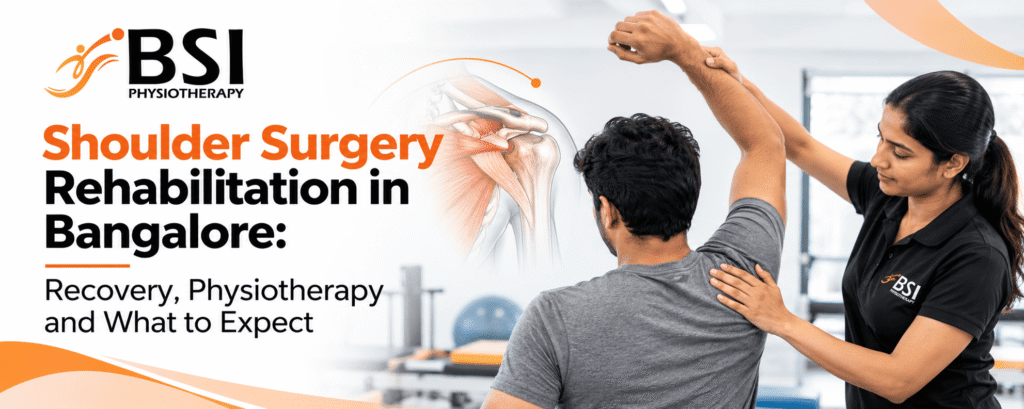
Recovering from shoulder surgery involves more than allowing the tissues to heal. Restoring shoulder movement, rebuilding strength, improving coordination, and returning safely to everyday activities are important parts of the recovery process.
Whether you have undergone rotator cuff repair, shoulder stabilisation surgery, a Latarjet procedure, or another shoulder operation, rehabilitation plays an important role in helping you regain function.
However, shoulder surgery rehabilitation in Bangalore is not a one-size-fits-all process. Your recovery programme depends on the type of surgery, the tissues involved, your surgeon’s instructions, and your individual recovery goals.
At BSI Physiotherapy, rehabilitation can be tailored to support patients recovering from shoulder surgery through a structured programme that progresses according to healing, movement, strength, and functional ability.
Why Is Physiotherapy Important After Shoulder Surgery?
Shoulder surgery may involve repairing tendons, stabilising the joint, treating damaged structures, or addressing other conditions affecting shoulder function. After surgery, movement and muscle strength may be temporarily restricted to protect the healing tissues.
Without an appropriate rehabilitation plan, some patients may experience persistent stiffness, reduced strength, difficulty performing daily activities, or delayed return to work and sports.
Post-operative physiotherapy aims to help patients:
● Restore shoulder mobility at the appropriate stage of healing.
● Improve strength and muscular control.
● Reduce movement-related limitations.
● Regain confidence using the affected arm.
● Return gradually to work, household activities, and exercise.
● Prepare for a safe return to sports when appropriate.
Rehabilitation must balance restoring movement with protecting the surgical repair. Starting exercises too aggressively can place unnecessary stress on healing tissues, while prolonged restriction beyond the prescribed period may contribute to stiffness.
Types of Shoulder Surgery That May Require Rehabilitation
Different shoulder procedures have different rehabilitation requirements. Understanding the procedure is essential when planning recovery.
1. Rotator Cuff Repair
The rotator cuff consists of four muscles and their tendons that help stabilise the shoulder and control arm movement. A significant tear may require surgical repair, depending on its characteristics and the patient’s circumstances.
After rotator cuff repair, rehabilitation generally focuses on protecting the repaired tendon before gradually restoring movement and strength.
The programme may include:
● Following prescribed sling and movement restrictions.
● Progressing from protected movement to assisted and active movement.
● Introducing strengthening when the repair has healed sufficiently.
● Rebuilding endurance and overhead function.
● Returning gradually to work, exercise, or sports.
The size of the tear, tissue quality, surgical technique, and surgeon’s protocol can significantly influence recovery.
2. Latarjet Procedure
The Latarjet procedure is commonly performed to address recurrent shoulder instability in selected patients, particularly when bone loss contributes to repeated dislocations.
Rehabilitation must account for the healing of the transferred bone and the surrounding surgical tissues.
The programme may involve protected early recovery, gradual restoration of movement, progressive strengthening, and later functional or sports-specific training.
External rotation and other movements may be restricted during particular stages. Patients should follow the operating surgeon’s instructions rather than attempting to accelerate their progress independently.
3. Arthroscopic Bankart Repair
A Bankart repair is used to address certain forms of shoulder instability involving damage to the labrum, the cartilage-like tissue around the shoulder socket.
After surgery, rehabilitation generally progresses from protection and prescribed mobility exercises to strengthening and functional movement training.
The timing of external rotation, overhead activity, and return to contact sports depends on the repair and the surgeon’s protocol.
4. Shoulder Replacement Surgery
Shoulder replacement may be recommended for selected patients with advanced arthritis or other significant joint conditions.
Rehabilitation focuses on gradually improving movement, restoring appropriate muscle function, and helping the patient perform everyday activities.
The type of replacement, the condition of the surrounding muscles and tendons, and any surgical restrictions influence the recovery plan.
5. Other Shoulder Procedures
Procedures such as selected labral repairs, biceps tendon surgery, and surgery for certain fractures may also require structured rehabilitation.
The exercises, precautions, and progression timelines vary. A programme designed for rotator cuff repair should not automatically be used for a different shoulder operation.
What Are the Stages of Shoulder Surgery Rehabilitation?
Although recovery differs between procedures, rehabilitation can often be understood through four broad stages.
These stages are a general framework, not a fixed schedule. Some patients progress more quickly than others, and certain procedures require longer periods of protection.
Stage 1: Protection and Early Recovery
Main goal: Protect healing tissues and manage early symptoms.
Immediately after surgery, your shoulder may be painful, swollen, or difficult to move. Your surgeon may prescribe a sling to protect the repair.
Early rehabilitation may include:
● Learning how to use and care for the sling.
● Following permitted movement restrictions.
● Managing everyday activities safely.
● Performing approved hand, wrist, and elbow movements.
● Learning comfortable positioning for rest and sleep.
● Understanding warning signs that require medical attention.
Not every patient is permitted to move the operated shoulder during this stage. The exact instructions depend on the surgery performed.
Stage 2: Restoring Shoulder Mobility
Main goal: Gradually improve movement without compromising healing.
When permitted, rehabilitation progresses towards restoring shoulder mobility.
Depending on the procedure, this may involve therapist-assisted movement, supported arm elevation, or other prescribed range-of-motion exercises.
Progress is monitored to ensure that movement remains within the permitted range.
Patients recovering from procedures involving tendon repair or shoulder stabilisation may have specific restrictions on rotation, elevation, or active muscle use.
Stage 3: Strengthening and Movement Control
Main goal: Rebuild strength and improve shoulder function.
Strengthening generally begins when the surgeon’s protocol and the patient’s healing status allow it.
Exercises may target the rotator cuff, shoulder blade muscles, and other supporting muscles. The programme may gradually introduce resistance, endurance work, and improved coordination.
Exercise difficulty should increase according to clinical assessment rather than a predetermined calendar alone.
Stage 4: Functional Rehabilitation and Return to Activity
Main goal: Prepare the shoulder for everyday demands, work, and sports.
Later rehabilitation focuses on activities that are important to the patient.
These may include:
● Reaching overhead.
● Lifting and carrying objects.
● Performing household tasks.
● Returning to gym-based exercise.
● Resuming work duties.
● Progressing towards throwing, swimming, or contact sports when appropriate.
Return to sport should be based on healing, strength, movement quality, functional testing, and medical clearance where required.
How Long Does Shoulder Surgery Rehabilitation Take?
Recovery time depends on the procedure, the severity of the original injury, healing, age, general health, and the demands placed on the shoulder.
The following are broad planning estimates, not individual predictions or clearance dates.
| Procedure | General recovery considerations |
|---|---|
| Rotator cuff repair | Rehabilitation commonly extends over several months; larger repairs may need longer. |
| Latarjet procedure | Bone healing, shoulder stability, and progressive functional recovery must be considered. |
| Bankart repair | Recovery involves protecting the stabilisation repair before progressing strength and activity. |
| Shoulder replacement | Recovery commonly takes several months, with progress depending on the type of replacement and individual factors. |
| Other shoulder procedures | Timelines vary according to the structures treated and the surgeon's protocol. |
Returning to everyday activities is not the same as being ready for heavy lifting or competitive sport. Each milestone should be assessed separately.
What Exercises Are Used After Shoulder Surgery?
Exercises depend on the operation and the stage of recovery. The following examples illustrate the types of movement that may be used when specifically permitted.
Hand and Wrist Movements
During some early recovery protocols, gentle hand opening and closing, wrist movement, and prescribed elbow movement help maintain mobility in areas that are not restricted.
Pendulum Exercises
When permitted, small, relaxed pendulum movements may be used to encourage gentle shoulder movement without actively lifting the arm.
Assisted Shoulder Movement
A physiotherapist may introduce assisted arm elevation or rotation once the prescribed protocol allows it.
Rotator Cuff and Shoulder Blade Strengthening
Later rehabilitation may include carefully progressed strengthening exercises for the shoulder muscles and shoulder blade stabilisers.
Functional and Sport-Specific Exercises
As recovery progresses, exercises may become more closely related to work tasks, gym activities, or sporting requirements.
Important: Do not start, advance, or modify these exercises without checking your post-operative instructions. Some movements that are appropriate after one shoulder procedure can be unsafe after another.
Common Challenges During Shoulder Surgery Recovery
Shoulder Stiffness
Some stiffness is common after shoulder surgery, particularly when movement has been restricted. However, the appropriate amount of movement depends on the procedure.
A physiotherapist can help distinguish between expected restrictions and movement problems that require further assessment.
Pain During Rehabilitation
Mild discomfort may occur during some stages of recovery, but severe or progressively worsening pain should not be ignored.
Your physiotherapist may need to adjust the exercise range, resistance, or activity level and coordinate with your surgeon when appropriate.
Weakness and Reduced Confidence
After a period of reduced use, the operated arm may feel weak or unfamiliar. Progressive strengthening and functional training can help rebuild confidence as healing allows.
Difficulty Returning to Sports
Athletes often need more than pain relief and basic mobility before returning to sport. They may require progressive strength, endurance, movement-control training, and sport-specific testing.
Returning too early may expose the shoulder to demands it is not ready to handle.
How to Choose a Shoulder Surgery Rehabilitation Physiotherapist in Bangalore
Choosing the right rehabilitation team can make the recovery process more organised and easier to monitor.
Consider the following factors:
Experience with post-operative shoulder rehabilitation: Look for a qualified physiotherapist familiar with the procedure you underwent.
Procedure-specific precautions: Your rehabilitation plan should reflect the operating surgeon’s instructions and the structures that require protection.
Individualised progression: Exercise difficulty should progress according to healing, symptoms, strength, and functional ability.
Regular reassessment: Your recovery should be monitored through movement, strength, functional milestones, and symptom changes.
Coordination with your surgeon: Communication is particularly important when symptoms worsen, progress stalls, or restrictions need clarification.
Convenient follow-up: A manageable rehabilitation schedule and a clear home exercise programme can help you follow the plan consistently.
Shoulder Surgery Rehabilitation at BSI Physiotherapy, Bangalore
Recovering from shoulder surgery requires a balance between protecting healing tissues and gradually restoring movement, strength, and function.
At BSI Physiotherapy in Bangalore, post-operative rehabilitation can be planned around the patient’s procedure, surgeon’s instructions, current abilities, and functional goals.
Depending on the operation and recovery stage, rehabilitation may involve protected mobility, progressive strengthening, movement-control exercises, functional training, and preparation for a gradual return to work or sports.
Whether you are recovering from rotator cuff repair, shoulder stabilisation surgery, a Latarjet procedure, or another shoulder operation, an individualised assessment can help establish the appropriate next steps.
Looking for shoulder surgery rehabilitation in Bangalore?
Contact BSI Physiotherapy to discuss your recovery needs and arrange an assessment with a qualified physiotherapist.
Website: https://www.bsiphysiotherapy.com/
Frequently Asked Questions
1. When should physiotherapy start after shoulder surgery?
The start date depends on the operation and the surgeon’s instructions. Some procedures allow protected movement early, while others require a longer period of immobilisation or restricted shoulder movement.
2. How many physiotherapy sessions are needed after shoulder surgery?
There is no fixed number of sessions for everyone. The frequency and duration depend on the procedure, recovery progress, functional goals, and the patient’s ability to perform prescribed exercises safely at home.
3. Is pain normal during shoulder rehabilitation?
Some discomfort may occur during recovery, but severe, sudden, or progressively worsening pain requires attention. Your physiotherapist and surgeon can help determine whether the rehabilitation programme needs to be adjusted.
4. Can I remove my sling to exercise?
Only follow the sling-removal and exercise instructions provided by your surgeon or rehabilitation team. Sling requirements vary between procedures, and removing it at the wrong time may compromise protection.
5. Can I drive after shoulder surgery?
Driving should resume only when it is medically appropriate, you are no longer impaired by medications, you can control the vehicle safely, and your treating clinician has confirmed that
it is appropriate. Sling use and local legal or insurance requirements must also be considered.
6. When can I return to the gym after shoulder surgery?
This depends on the operation, healing progress, movement restrictions, and strength. Returning to lower-body exercise, light upper-body training, and heavy overhead lifting may require different timelines and approvals.
7. When can I return to sports after shoulder surgery?
Return to sport depends on the procedure and the demands of the sport. The decision should consider healing, pain, strength, range of motion, movement control, functional testing, and medical clearance where necessary.
8. What should I do if my shoulder becomes more painful after surgery?
Contact your treating clinical team if pain increases significantly or unexpectedly. Seek urgent medical attention for symptoms such as fever with wound redness or drainage, rapidly increasing swelling, chest pain, breathlessness, or sudden changes in arm sensation or circulation.
Conclusion
Shoulder surgery rehabilitation is an important part of recovering movement, strength, and functional ability after an operation. The process differs according to the procedure, and the timing of exercises must respect tissue healing and the surgeon’s instructions.
With appropriate guidance, progressive rehabilitation, and regular reassessment, patients can work towards their individual recovery goals and a safe return to daily activities, work, and sports.
If you are looking for shoulder surgery rehabilitation in Bangalore, BSI Physiotherapy can help you explore an appropriate rehabilitation plan based on your procedure and recovery needs.
Medical disclaimer: This article is for educational purposes only and does not replace individual medical advice, a post-operative review, or the rehabilitation protocol provided by your treating surgeon.