
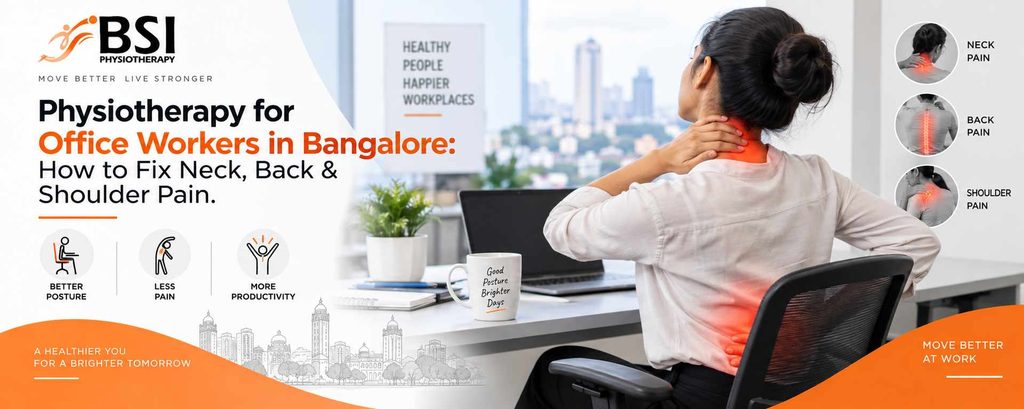
For many office workers in Bangalore, spending several hours at a desk can become a daily challenge for the neck, back and shoulders.
Long periods of sitting, frequent laptop use, limited movement during the workday and the demands of commuting can contribute to stiffness, discomfort and reduced physical activity.
But office-related pain isn’t simply a problem of having “bad posture.” A combination of prolonged static positions, insufficient movement, muscle capacity, workload and lifestyle factors can influence how your body feels.
The good news is that physiotherapy, exercise and simple changes to your work routine can help you manage these problems and improve your ability to work comfortably.
If you’re searching for physiotherapy in Bangalore, here’s what office workers should know about neck, back and shoulder pain.
Why Do Office Workers Develop Neck, Back and Shoulder Pain?
Office work often involves maintaining relatively static positions for long periods.
Common contributing factors include:
- Sitting for prolonged periods
- Working on laptops
- Looking down at screens
- Limited movement during the workday
- Repetitive mouse or keyboard use
- Poorly adjusted workstations
- Long commuting hours
- Lack of regular exercise
- Stress and inadequate recovery
However, pain doesn’t necessarily mean that one particular posture has damaged your spine.
Your body is designed to move. Spending less time in one position and incorporating regular movement throughout the day can be useful.
Neck Pain From Desk Work
Neck discomfort is common among people who spend significant amounts of time working at computers.
You may notice:
- Neck stiffness
- Pain when turning your head
- Tightness around the neck and upper shoulders
- Headaches associated with neck discomfort
- Discomfort after prolonged screen use
Rather than focusing only on “perfect posture,” it can be more useful to consider how long you stay in one position and how often you move.
What Can Help?
Depending on the individual, physiotherapy may include:
- Neck mobility exercises
- Upper-back mobility
- Strengthening exercises
- Shoulder blade control
- Workstation modifications
- Movement breaks
- Gradual return to normal activity
Shoulder Pain in Office Workers
Shoulder discomfort may develop alongside prolonged computer work, particularly when the upper limb remains in relatively static positions for long periods.
Common symptoms can include:
- Shoulder stiffness
- Pain while reaching
- Upper shoulder tightness
- Discomfort when working at a computer
- Reduced tolerance for prolonged desk work
Shoulder rehabilitation isn’t simply about stretching.
Depending on the cause, a physiotherapist may assess:
- Shoulder movement
- Strength
- Rotator cuff function
- Shoulder blade movement
- Upper-back mobility
- Work-related activities
Treatment may then include progressive strengthening and movement exercises.
Back Pain From Prolonged Sitting
Lower back discomfort is another common complaint among desk-based workers.
Long periods of sitting may be associated with reduced physical activity and increased discomfort in some people.
However, sitting itself isn’t necessarily harmful.
Instead of trying to maintain one “perfect” sitting posture all day, consider regularly changing positions and incorporating movement into your workday.
Strategies That May Help
- Stand up regularly
- Walk during short breaks
- Change sitting positions
- Adjust your workstation
- Incorporate regular exercise
- Build trunk and lower-limb strength
- Avoid suddenly increasing physical activity after a sedentary workday
Is Poor Posture Really the Main Problem?
Posture is often blamed for office-related pain, but the relationship is more complicated.
There is no single posture that guarantees you’ll never experience back or neck pain.
A more practical approach is to develop the ability to tolerate different positions and move regularly throughout the day.
For example, instead of worrying about whether your shoulders are perfectly positioned every minute, consider:
How long have I been sitting?
When was my last movement break?
Do I exercise regularly?
Can I comfortably perform the physical demands of my job?
These questions may be more useful than constantly trying to “correct” your posture.
How Physiotherapy Can Help Office Workers
Physiotherapy can take a broader approach to office-related pain.
An assessment may look at:
- Neck mobility
- Shoulder movement
- Spinal mobility
- Muscle strength
- Functional capacity
- Workstation habits
- Physical activity
- Exercise tolerance
- Symptoms during work
Based on the assessment, your physiotherapist can develop an individual rehabilitation programme.
This may include:
Exercise Therapy
Exercises may target areas such as the neck, upper back, shoulders, trunk and hips.
Strength Training
Building physical capacity can help you tolerate work and everyday activities more comfortably.
Mobility Exercises
Mobility work may be used when restricted movement is contributing to symptoms.
Manual Therapy
Hands-on techniques may be used when clinically appropriate, particularly as part of a broader rehabilitation programme.
Ergonomic Advice
Small changes to your workstation and work routine may help reduce unnecessary strain.
Movement Strategies
Your physiotherapist can help you develop practical ways to incorporate more movement into your workday.
Simple Desk Habits That Can Help
You don’t necessarily need to completely redesign your working life.
Try incorporating simple habits such as:
1. Take Regular Movement Breaks
Stand up, walk around or change position periodically rather than remaining seated for several hours continuously.
2. Keep Your Screen at a Comfortable Height
Your screen should be positioned so that you don’t have to constantly look down.
3. Use an External Keyboard With a Laptop
If you work on a laptop for long periods, an external keyboard and mouse can allow you to position the screen and hands more comfortably.
4. Avoid Holding Your Phone Between Your Shoulder and Ear
Use a headset or speakerphone when appropriate for longer calls.
5. Include Exercise Outside Work
A short walk, strength-training session or other physical activity can help counter a highly sedentary workday.
What Exercises Are Useful for Office Workers?
There isn’t one exercise routine that works for everyone.
Depending on your symptoms and physical capacity, a programme may include:
- Chin-tuck or neck-control exercises
- Thoracic mobility exercises
- Shoulder strengthening
- Rotator cuff exercises
- Rowing movements
- Core strengthening
- Hip strengthening
- Walking
- General resistance training
Exercises should be selected according to the individual’s condition.
If you have significant pain, don’t assume that an exercise is appropriate simply because it is recommended online.
Can Physiotherapy Prevent Office-Related Pain?
Physiotherapy isn’t a guarantee against future pain.
However, rehabilitation and exercise can help improve physical capacity, movement confidence and your ability to manage symptoms.
For office workers, prevention is often about building sustainable habits:
Move regularly + exercise consistently + adjust your workstation + manage workload + respond early to persistent symptoms.
When Should an Office Worker See a Physiotherapist?
You may want to consider an assessment if:
- Neck, back or shoulder pain persists
- Symptoms repeatedly return
- Pain interferes with your work
- You have difficulty exercising
- Your movement is restricted
- You notice weakness
- Pain is affecting sleep or daily activities
- You have tried changing your routine without improvement
Early assessment can help you understand what’s contributing to your symptoms and what you can do about them.
What About Working From Home?
Working from home doesn’t automatically eliminate office-related pain.
In fact, home workers may spend long periods working from:
- Sofas
- Beds
- Dining tables
- Unsuitable chairs
- Small laptop setups
A home workstation should be comfortable and practical for prolonged work.
If possible, create a dedicated workspace with an appropriate chair, desk, screen and keyboard setup.
More importantly, avoid spending the entire workday in one position.
Physiotherapy in Bangalore for Office Workers
Bangalore has a large population of IT professionals and desk-based workers, making musculoskeletal problems particularly relevant to working adults.
If you’re searching for physiotherapy in Bangalore for neck, back or shoulder pain, treatment should focus on more than temporary symptom relief.
At BSI Physiotherapy, assessment can consider your symptoms, movement, strength, work requirements and activity level.
Depending on your needs, rehabilitation may include:
- Exercise therapy
- Strength training
- Mobility work
- Ergonomic guidance
- Manual therapy where appropriate
- Posture and movement education
- Progressive return to exercise
The goal is to help you develop the physical capacity and habits needed to manage your work and everyday activities more comfortably.
Frequently Asked Questions
Can physiotherapy help neck pain caused by office work?
Physiotherapy may help by addressing factors such as movement restrictions, strength deficits, physical capacity and work-related habits. The appropriate treatment depends on the underlying cause of your symptoms.
How often should office workers take breaks?
There isn’t one universal break schedule that works for everyone. The practical goal is to avoid remaining in the same position for prolonged periods and to incorporate regular movement throughout the working day.
Is sitting all day bad for your back?
Prolonged sedentary behaviour can contribute to reduced physical activity and discomfort. Regular movement, exercise and changing positions can help you avoid spending the entire day in one static position.
Can physiotherapy fix poor posture?
Physiotherapy doesn’t necessarily aim to create one “perfect” posture. It can help you improve movement, strength and your ability to tolerate different positions.
Should I exercise if I have back or neck pain?
Exercise can be an important part of managing many musculoskeletal conditions, but the appropriate type and intensity depend on your symptoms and condition. A physiotherapist can help determine an appropriate programme.
How long does physiotherapy take to help office-related pain?
There is no fixed timeline. Recovery depends on the cause and severity of the symptoms, your physical activity, exercise adherence and other individual factors.
Final Takeaway
Your desk doesn’t have to be your biggest source of pain.
For office workers, managing neck, back and shoulder discomfort isn’t necessarily about maintaining perfect posture all day.
It’s about creating a healthier combination of:
- Regular movement
- Appropriate exercise
- Workstation adjustments
- Strength and mobility
- Adequate recovery
- Early attention to persistent symptoms
If neck, back or shoulder pain is affecting your work or daily life, a physiotherapy assessment can help you understand the problem and develop an appropriate rehabilitation plan.
Looking for physiotherapy in Bangalore? BSI Physiotherapy provides assessment and rehabilitation for musculoskeletal, orthopaedic and sports-related conditions.
Medical note: This article is for general educational purposes and does not replace an individual assessment by a qualified healthcare professional. Persistent, severe or unexplained pain should be evaluated appropriately.