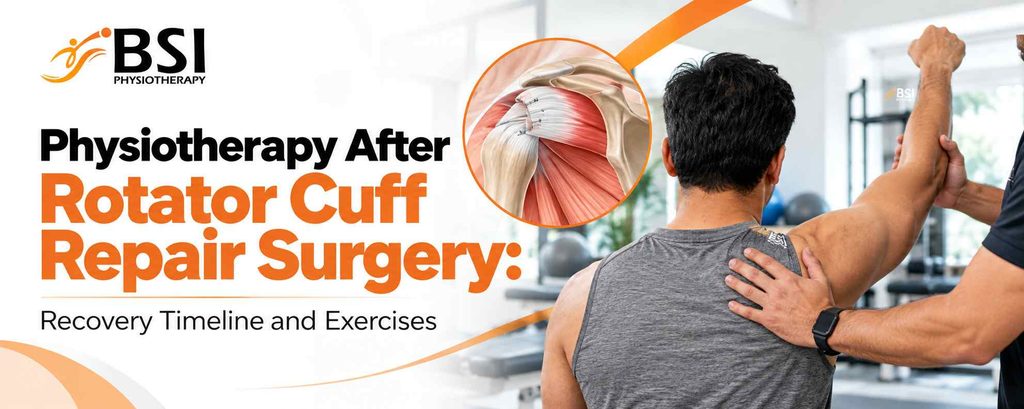
Recovering from rotator cuff surgery? Physiotherapy plays an important role in helping you regain shoulder movement, rebuild strength and return to everyday activities safely. However, recovery takes time, and the right rehabilitation plan depends on the type of repair, the size of the tear and your surgeon’s instructions.
If you’re looking for physiotherapy after rotator cuff repair surgery in Bangalore, understanding the stages of recovery can help you prepare for rehabilitation and avoid putting unnecessary stress on the healing tendon.
At BSI Physiotherapy, rehabilitation should be approached as a gradual, structured process that prioritises tissue healing, controlled movement and a safe return to function.
What Is Rotator Cuff Repair Surgery?
The rotator cuff is a group of four muscles and their tendons that help stabilise the shoulder joint and control arm movements. These tendons play an important role when you lift your arm, reach overhead, get dressed or perform activities such as swimming and playing badminton.
A rotator cuff tear can develop following an injury, repetitive overhead movements or age-related tendon changes. When symptoms persist or the tear is significant, an orthopaedic surgeon may recommend surgical repair.
During rotator cuff repair surgery, the torn tendon is reattached to the upper arm bone. The procedure is often performed arthroscopically, using small incisions and a camera.
Although surgery repairs the tendon, the shoulder still needs time to heal. The surrounding muscles may be weak, and movement can remain restricted for several weeks or months. This is where post-operative shoulder physiotherapy in Bangalore can help patients progress through a supervised rehabilitation programme
Why Is Physiotherapy Important After Rotator Cuff Repair?
After surgery, you may experience stiffness, discomfort, reduced shoulder movement and difficulty performing simple tasks. These problems are common during recovery, but rehabilitation must be carefully planned to protect the repair.
Physiotherapy can help with:
- Restoring shoulder mobility: Gradually improving movement as permitted by the surgeon.
- Managing stiffness: Reducing the risk of prolonged movement restrictions through appropriate rehabilitation.
- Rebuilding strength: Progressively improving the strength and control of the shoulder and surrounding muscles.
- Improving daily function: Working towards activities such as dressing, grooming, reaching and lifting.
- Regaining confidence: Helping patients return to work, exercise and recreational activities at an appropriate pace.
The aim isn’t to force the shoulder to move as quickly as possible. It’s to restore function without placing excessive strain on the healing tendon. Rehabilitation recommendations are based on clinical guidance and the details of the individual repair. [1, 2]
Rotator Cuff Repair Recovery Timeline: What to Expect
Recovery varies between patients. A small tear may follow a different rehabilitation pathway from a large or complex tear. Your surgeon may also modify the protocol depending on tendon quality, associated procedures and how securely the tendon was repaired.
The following timeline is a general overview, not a personalised exercise prescription.
Phase 1: Protection and Early Recovery (Weeks 0–4)
The first priority is protecting the repaired tendon.
Your surgeon may recommend wearing a sling for several weeks, often around four to six weeks, depending on the repair and individual circumstances.
During this stage, rehabilitation may focus on:
- Learning how to wear and manage the sling.
- Keeping the elbow, wrist and fingers moving when permitted.
- Understanding safe sleeping positions and getting dressed without straining the shoulder.
- Managing discomfort and swelling according to medical advice.
- Beginning therapist-assisted passive shoulder movement only when authorised.
Important: Do not lift objects, push yourself up using the operated arm or perform unauthorised shoulder exercises during this phase.
Some patients may be prescribed a more protective protocol, especially after a large tear or a subscapularis repair. Follow your surgeon’s instructions rather than a generic online timeline.
Phase 2: Gradual Restoration of Movement (Weeks 4–6 and Beyond)
Once the surgeon confirms that progression is appropriate, physiotherapy may begin to focus more on restoring shoulder mobility.
Depending on the surgical protocol, treatment may include:
- Passive range-of-motion exercises.
- Therapist-guided shoulder movement.
- Carefully selected assisted movements when permitted.
- Education about posture and avoiding compensatory movements.
Passive movement means the shoulder is moved with assistance rather than relying on the repaired muscles to lift the arm.
Not every patient begins these activities at the same time. A larger repair may require a longer period of protection.
Phase 3: Active Movement and Motor Control (Approximately Weeks 6–12)
As healing progresses and clearance is provided, rehabilitation may gradually introduce active-assisted and active shoulder movements.
The goals are to improve movement control, reduce compensatory shoulder hiking and help the patient regain confidence when moving the arm.
Exercises may include:
- Therapist-guided active-assisted elevation.
- Supported shoulder movements within the permitted range.
- Gentle shoulder blade control exercises.
- Gradual practice of light functional movements.
The exact start date depends on the repair. Moving against gravity too early can overload the tendon, so progression should be based on clinical assessment and surgical guidance.
Phase 4: Progressive Strengthening (Often Around Weeks 12–16 Onwards)
Strengthening is introduced when the repaired tendon is sufficiently healed and the treating team considers it appropriate.
The programme may progress from low-load exercises to resistance-based training, depending on pain, movement quality and strength.
Rehabilitation can include:
- Rotator cuff strengthening.
- Shoulder blade and upper-back strengthening.
- Resistance-band exercises.
- Gradual improvement in endurance and movement control.
- Functional exercises based on work and daily activities.
Some patients require a longer period before strengthening begins. Avoid starting weights or resistance bands simply because a particular week has been reached.
Phase 5: Return to Work, Sports and Daily Activities (Approximately 4–6 Months or Longer)
Later rehabilitation focuses on returning to activities that require greater strength, coordination and endurance.
Depending on your goals, physiotherapy may address:
- Reaching overhead.
- Lifting and carrying objects.
- Work-related shoulder demands.
- Swimming, gym training or recreational sports.
- Sport-specific movement and progressive loading.
Many patients need several months to regain useful movement and strength. Full recovery can take six months or longer, and some complex repairs require additional time. Return to demanding activities should depend on clinical milestones rather than the calendar alone. [2, 3]
Exercises After Rotator Cuff Repair Surgery
One of the most common questions patients ask is, “Which exercises should I do after shoulder surgery?”
The answer depends on your surgical protocol. An exercise that is appropriate several weeks after a small repair may be unsafe immediately after a larger repair.
The following are examples of exercise categories used during rehabilitation. They should not be treated as a home exercise prescription without approval from your surgeon or physiotherapist.
1. Hand, Wrist and Elbow Movements
These movements help maintain mobility in the parts of the arm that are not restricted by your post-operative instructions.
Examples include gently opening and closing the hand, moving the wrist and bending or straightening the elbow when permitted.
Keep the upper arm supported as instructed, and do not use these movements as an opportunity to lift or rotate the operated shoulder.
2. Passive Shoulder Range of Motion
In passive exercises, the therapist or an approved assistance technique moves the shoulder without requiring the repaired muscles to actively lift the arm.
These exercises are introduced only when allowed by the surgeon. The permitted direction, range and amount of movement vary with the repair.
3. Assisted Shoulder Elevation
At an appropriate stage, the patient may use the opposite arm or another approved assistance method to help move the operated arm.
The movement should remain within the prescribed range and should not involve forcing the shoulder through pain or stiffness.
4. Shoulder Blade Control Exercises
Scapular control exercises may be introduced to improve awareness and control of the shoulder blade.
The timing and technique matter. Avoid forceful squeezing, shrugging or other movements that contradict your post-operative restrictions.
5. Resistance-Band Strengthening
Resistance bands may be introduced during the strengthening phase after the treating team confirms that the repair is ready.
External rotation, internal rotation and other shoulder exercises may form part of a later programme, but they are not suitable for every patient at every stage.
Never begin a new shoulder exercise, increase resistance or stop using your sling based only on advice from a blog or video.
Common Mistakes to Avoid After Rotator Cuff Surgery
Even when pain begins to improve, the tendon may still be healing. Avoid these common mistakes:
1. Starting exercises too early: Early loading can place unnecessary stress on the repair.
2. Lifting heavy objects: Shopping bags, water cans and household items may place more strain on the shoulder than expected.
3. Removing the sling without clearance: Sling use should follow the surgeon’s instructions.
4. Progressing exercises too quickly: More repetitions or greater resistance do not automatically mean faster recovery.
5. Ignoring changes in symptoms: A sudden increase in pain or a new loss of function deserves medical attention.
6. Comparing your recovery with someone else’s: Tear size, tendon quality, age, general health and surgical technique can all influence progress.
When Should You Contact Your Surgeon?
Some discomfort and stiffness may occur after surgery. However, contact your surgical team promptly if you notice increasing redness or warmth around the incision, wound discharge, fever or pain that is worsening rather than settling.
Seek urgent medical care for chest pain, sudden shortness of breath or other severe, unexpected symptoms.
A sudden pop accompanied by new severe pain or a marked loss of shoulder function should also be assessed promptly.
Do not attempt to manage concerning post-operative symptoms by simply adding more exercises.
Choosing Post-Surgical Physiotherapy in Bangalore
When choosing a rehabilitation provider, look for a physiotherapist experienced in post-operative shoulder rehabilitation who can work within your surgeon’s protocol.
Useful questions to ask include:
- Does the physiotherapist have experience rehabilitating rotator cuff repairs?
- Will the programme follow the surgeon’s post-operative instructions?
- How will shoulder movement, pain and strength be assessed over time?
- Will the exercise programme change as recovery progresses?
- Can the therapist help plan a safe return to work and sport?
For patients seeking shoulder physiotherapy in Bangalore, convenient access to rehabilitation can make it easier to attend appointments and maintain a consistent home programme.
BSI Physiotherapy provides a setting to explore physiotherapy and rehabilitation options for shoulder-related conditions. The appropriate programme should be determined following an individual assessment and review of your surgical instructions.
Frequently Asked Questions
How long does physiotherapy take after rotator cuff repair surgery?
Rehabilitation commonly continues for several months. Many patients work towards functional recovery over four to six months or longer, depending on the tear, repair and activity demands. More complex cases may require additional time.
When can I start physiotherapy after rotator cuff surgery?
Rehabilitation planning may begin around the time of surgery, but the timing of shoulder exercises depends on the surgeon’s protocol. Early sessions may focus on education and permitted movements before progressing to shoulder mobility and strengthening.
Can I do rotator cuff exercises at home?
Yes, when your physiotherapist or surgeon has prescribed the exercises and explained how to perform them safely. Do not copy exercises designed for another patient’s recovery stage.
Is shoulder pain normal during physiotherapy after surgery?
Some discomfort may occur, but sharp, severe or worsening pain should not be ignored. Tell your physiotherapist about changes in symptoms so the programme can be reviewed.
Can I return to the gym after rotator cuff repair?
Returning to the gym depends on healing, strength, movement control and clearance from your treating team. Heavy lifting and overhead training generally require a carefully planned progression.
Where can I get physiotherapy after rotator cuff repair surgery in Bangalore?
Look for a qualified physiotherapist with experience in post-operative shoulder rehabilitation. Ask whether the programme will be coordinated with your orthopaedic surgeon and tailored to your repair.
Start Your Shoulder Rehabilitation With a Structured Plan
Rotator cuff repair is only one part of the recovery process. Protecting the tendon, restoring movement at the right time and progressively rebuilding strength all contribute to functional recovery.
If you’re looking for post-surgical physiotherapy in Bangalore, BSI Physiotherapy can help you explore appropriate shoulder rehabilitation options based on your surgical instructions, current mobility and recovery goals.
Speak with your surgeon and physiotherapist before starting or changing any exercise programme.
Medical References
- American Academy of Orthopaedic Surgeons (AAOS). Management of Rotator Cuff Injuries: Clinical Practice Guideline, 2025. https://www.aaos.org/quality/quality-programs/rotator-cuff/
- AAOS OrthoInfo. Rotator Cuff Tears: Surgical Treatment Options. https://www.orthoinfo.org/treatment/rotator-cuff-tears-surgical-treatment-options/
- Frimley Health NHS Foundation Trust. Guidelines for Patients Having a Rotator Cuff Repair. https://www.fhft.nhs.uk/patients-and-visitors/patient-information-library/guidelines-patients-rotator-cuff-repair
Medical disclaimer: This article is for general educational purposes and does not replace advice from your orthopaedic surgeon or physiotherapist. Your rehabilitation plan must be individualised to your surgery and clinical condition.