Physiotherapy After Latarjet Surgery: Recovery, Rehabilitation and Exercises
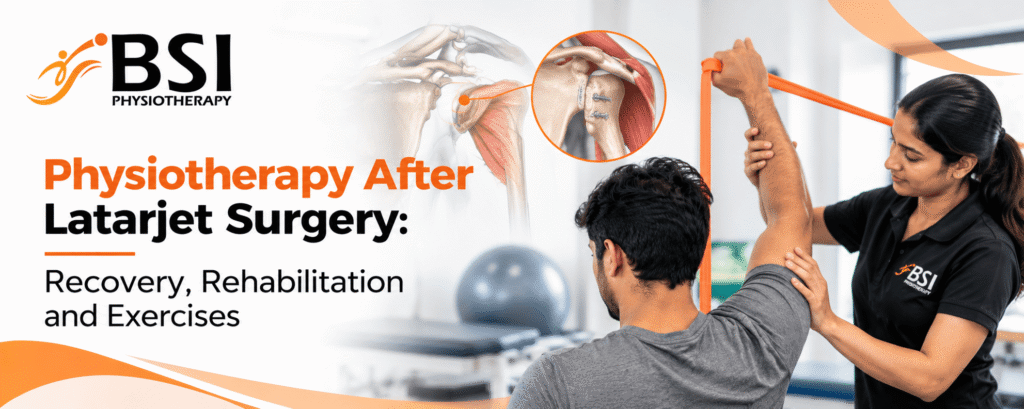
A Latarjet procedure is a type of shoulder stabilisation surgery performed to treat certain cases of recurrent shoulder dislocation and instability. The procedure involves transferring a portion of bone from the coracoid process to the front of the shoulder socket to improve stability in selected patients.
Although surgery can help address the structural problems contributing to shoulder instability, rehabilitation is an important part of the recovery process. Patients need to regain appropriate shoulder movement, rebuild muscle strength, improve movement control, and gradually return to their daily activities and sports.
Physiotherapy after Latarjet surgery must be carefully planned because the transferred bone and surrounding tissues need sufficient time to heal. Starting certain movements or strengthening exercises too early may place unnecessary stress on the surgical repair.
At BSI Physiotherapy in Bangalore, post-operative shoulder rehabilitation can be tailored to the surgical procedure, the operating surgeon’s instructions, the patient’s recovery progress, and their functional goals.
What Is Latarjet Surgery?
The Latarjet procedure is commonly recommended for selected patients with recurrent anterior shoulder instability, particularly when there is significant bone loss from the front of the shoulder socket or when other factors increase the risk of repeated dislocation.
During the procedure, the coracoid process, a small bony projection of the shoulder blade, is transferred to the front of the glenoid, which forms part of the shoulder socket.
The procedure can improve stability through three main mechanisms:
● Bony augmentation: The transferred bone helps increase the available support at
the front of the shoulder socket.
● Dynamic stabilisation: The transferred tendon and muscle attachments can
contribute to stability during certain arm positions.
● Capsular repair: When included in the surgical technique, repair of the capsule can
provide additional stabilising support.
The specific surgical technique and the structures repaired influence the rehabilitation
protocol.
Why Is Physiotherapy Important After Latarjet Surgery?
Following Latarjet surgery, the shoulder may initially be painful, stiff, weak, and difficult to
move. The arm may also need to remain in a sling for the period prescribed by the surgeon.
Rehabilitation aims to restore function while protecting the healing bone transfer and other
surgical tissues.
A structured physiotherapy programme can help patients:
● Restore shoulder movement within the permitted range.
● Maintain mobility in the elbow, wrist, and hand when allowed.
● Gradually rebuild rotator cuff and shoulder blade muscle strength.
● Improve shoulder control and coordination.
● Regain confidence during daily activities.
● Prepare for a gradual return to work, exercise, and sports.
The aim is not to achieve the greatest possible range of motion as quickly as possible. It is to
restore appropriate movement and stability without compromising healing.
Stages of Physiotherapy After Latarjet Surgery
The following stages describe a general rehabilitation framework. They are not a substitute
for your surgeon’s protocol. Exact timelines, permitted movements, and strengthening
milestones vary between patients and surgical techniques.
Stage 1: Protection and Early Recovery
Primary goal: Protect the surgical repair and support early healing.
During the initial postoperative period, the shoulder may be protected using a sling. The
duration of sling use and the movements permitted depend on the operating surgeon’s
instructions.
Rehabilitation may focus on:
● Understanding sling use and prescribed precautions.
● Maintaining comfortable positioning for rest and sleep.
● Performing approved hand, wrist, and elbow movements.
● Managing daily activities safely.
● Following wound-care and postoperative instructions.
● Learning which shoulder movements must temporarily be avoided.
Shoulder movement should not be started independently if the surgeon has prescribed a
period of immobilisation or specific restrictions.
Stage 2: Gradual Restoration of Shoulder Mobility
Primary goal: Improve movement while respecting healing restrictions.
When permitted, the rehabilitation programme may progress to assisted or passive shoulder
movements.
The physiotherapist monitors shoulder elevation and rotation according to the prescribed
protocol. Particular care may be required with external rotation, especially when the arm is
positioned away from the body.
The aim is to restore movement gradually without forcing the shoulder or placing excessive
stress on healing structures.
Patients should not attempt to regain their preoperative range of motion through aggressive
stretching.
Stage 3: Active Movement and Early Strengthening
Primary goal: Improve movement control and begin rebuilding strength.
As healing progresses and the surgeon’s protocol allows, patients may gradually transition
towards active shoulder movement.
Later, suitable exercises may be introduced for the rotator cuff and shoulder blade muscles.
Rehabilitation may include:
● Controlled arm elevation.
● Gentle shoulder muscle activation.
● Scapular control exercises.
● Progressively challenging movement tasks.
● Carefully selected resistance exercises when permitted.
Exercise progression depends on symptoms, movement quality, healing, and clinical
assessment rather than time alone.
Stage 4: Progressive Strengthening and Functional Training
Primary goal: Restore the strength and control needed for everyday activities.
As the shoulder tolerates increasing demands, rehabilitation may progress towards more
challenging strengthening exercises.
Training can focus on the rotator cuff, shoulder blade stabilisers, and coordinated movement
of the shoulder and upper limb.
Functional activities may include reaching, carrying light objects, lifting tasks, and other
movements relevant to the patient’s work and daily routine.
The programme must continue to respect any remaining restrictions and the surgeon’s
advice.
Stage 5: Return to Sports and Higher-Level Activities
Primary goal: Prepare the shoulder for demanding activities and reduce the risk of reinjury.
Athletes may require additional rehabilitation before returning to throwing, swimming, racket
sports, weight training, or contact sports.
Readiness may be assessed through:
● Adequate shoulder movement within the required range.
● Sufficient strength and endurance.
● Good movement control.
● Tolerance of progressively demanding exercises.
● Completion of sport-specific rehabilitation tasks.
● Medical clearance when required.
Returning to sport should not be based on pain relief alone. The shoulder must be
sufficiently healed and able to tolerate the demands of the intended activity.
Which Exercises Are Used After Latarjet Surgery?
Exercises depend on the postoperative stage and the surgeon’s instructions. The following
examples illustrate common categories of rehabilitation exercises, but they are not a
personal exercise prescription.
1. Hand, Wrist and Elbow Movements
When permitted, gentle movements of the hand, wrist, and elbow can help maintain mobility
in areas not restricted by the surgical protocol.
These movements should be performed without compromising the prescribed position or
protection of the operated shoulder.
2. Assisted Shoulder Movement
When shoulder movement is authorised, a physiotherapist may introduce carefully controlled
assisted movements.
The permitted range and direction depend on the repair and the operating surgeon’s
instructions.
3. Shoulder Blade Control
Later in rehabilitation, exercises may focus on improving control of the shoulder blade and its
coordination with arm movement.
These exercises should be introduced when appropriate rather than performed automatically
during the early recovery period.
4. Rotator Cuff Strengthening
Progressive strengthening may be introduced after the initial protection period, according to
healing and the prescribed protocol.
Resistance, exercise selection, and repetitions should be determined by the physiotherapist
based on the patient’s progress.
5. Functional and Sports-Specific Exercises
Later-stage rehabilitation may include progressively demanding lifting, reaching, balance,
coordination, and sport-specific movements.
These exercises prepare the shoulder for real-world demands and should be introduced only
when the patient meets the relevant rehabilitation milestones.
Important: Do not begin external rotation stretching, resistance-band exercises, push-ups,
overhead lifting, or other demanding shoulder exercises without confirming that they are
appropriate for your current postoperative stage.
How Long Does Recovery Take After Latarjet Surgery?
Recovery after a Latarjet procedure usually takes several months, and the time required to
return to demanding activities or competitive sports can be longer.
The exact timeline depends on several factors:
● Healing of the transferred bone.
● The surgical technique and any additional repairs.
● Preoperative shoulder function.
● Pain, stiffness, and strength.
● Adherence to the prescribed rehabilitation programme.
● The physical demands of work or sport.
Different recovery milestones should be considered separately. Being able to perform
everyday tasks does not necessarily mean that the shoulder is ready for heavy lifting or
contact sports.
| Recovery milestone | What it involves |
|---|---|
| Early recovery | Protecting the repair and following postoperative precautions. |
| Mobility recovery | Gradually restoring permitted shoulder movement. |
| Strength recovery | Rebuilding muscle strength and movement control. |
| Functional recovery | Returning to everyday tasks and work demands. |
| Sports recovery | Meeting appropriate strength, movement, and sport-specific criteria before returning to competition. |
These are general stages rather than guaranteed deadlines. The operating surgeon and
rehabilitation team should determine when it is appropriate to progress between them.
Common Challenges During Latarjet Rehabilitation
Shoulder Stiffness
Some restriction of movement may be expected during the protected recovery period.
However, stiffness should be managed according to the prescribed protocol.
Do not force the shoulder to achieve full external rotation or elevation before it is permitted.
Pain During Exercise
Some discomfort may occur during recovery, but severe, unexpected, or progressively
worsening pain should not be ignored.
Your physiotherapist may need to modify the rehabilitation programme or contact your
surgeon to clarify the next steps.
Muscle Weakness
After a period of restricted movement, the shoulder and surrounding muscles may become
weaker. Progressive strengthening helps rebuild capacity when it is safe to do so.
Fear of Recurrent Dislocation
Some patients feel anxious when moving their arm into positions associated with previous
dislocations.
Rehabilitation can gradually rebuild confidence through controlled movement, strength
training, and functional progression. However, movements that remain restricted by the
surgical protocol must be avoided until cleared.
Returning to Sport Too Early
Athletes may feel ready to resume training before their shoulder has regained sufficient
strength, control, or structural healing.
A gradual return-to-sport plan and appropriate assessment are important, especially for
activities involving contact, throwing, or forceful overhead movements.
When Should You Contact Your Surgeon After Latarjet Surgery?
Contact your treating clinical team if you experience unexpected increases in pain,
worsening movement, or concerns about the surgical wound.
Seek urgent medical attention if you develop:
● Fever accompanied by increasing wound redness or drainage.
● Rapidly increasing swelling.
● Sudden severe pain following a fall or injury.
● New or worsening numbness, weakness, or changes in hand colour or temperature.
● Chest pain or difficulty breathing.
Follow the discharge instructions provided by your surgical team, as they will be specific to
your procedure and recovery.
How to Choose a Physiotherapist for Latarjet Rehabilitation in Bangalore
Latarjet rehabilitation requires an understanding of shoulder instability, surgical precautions,
and progressive return to activity.
When choosing a physiotherapist, consider the following:
Experience with shoulder stabilisation procedures: Look for experience in rehabilitation
following Latarjet and other shoulder instability surgeries.
Understanding of surgical precautions: The rehabilitation plan should follow the operating
surgeon’s instructions, including restrictions on movement and strengthening.
Individualised progression: Exercise difficulty should reflect healing, strength, mobility,
symptoms, and functional milestones.
Regular progress assessment: Your movement, strength, and ability to perform daily
activities should be reviewed throughout recovery.
Communication with the surgeon: Coordination is particularly important if symptoms
worsen or progress does not follow the expected course.
Return-to-sport planning: If you are an athlete, ask how strength, movement control, and
sport-specific readiness will be assessed before you return to training or competition.
Latarjet Surgery Rehabilitation at BSI Physiotherapy, Bangalore
Recovery after a Latarjet procedure requires a careful balance between protecting the
surgical repair and gradually restoring shoulder function.
At BSI Physiotherapy in Bangalore, rehabilitation can be tailored to the patient’s surgical
procedure, prescribed restrictions, recovery progress, and individual goals.
Depending on the stage of recovery, the programme may involve protected mobility,
progressive strengthening, movement-control training, functional rehabilitation, and
preparation for a gradual return to sports or other demanding activities.
Whether you are recovering from recurrent shoulder dislocation surgery or preparing to
return to an active lifestyle, a structured rehabilitation plan can help you understand your
recovery milestones and work towards your functional goals.
Looking for physiotherapy after Latarjet surgery in Bangalore?
Contact BSI Physiotherapy to discuss your postoperative rehabilitation needs and arrange
an assessment with a qualified physiotherapist.
Website: https://www.bsiphysiotherapy.com/
Frequently Asked Questions
1. When should physiotherapy start after Latarjet surgery?
The start date and permitted movements depend on the operating surgeon’s protocol. Some
rehabilitation activities may begin early, while shoulder movement and strengthening may be
restricted for a specific period.
2. How long does it take to recover from Latarjet surgery?
Recovery generally takes several months. Returning to heavy lifting or competitive sports
may take longer and depends on bone healing, shoulder function, strength, and medical
clearance.
3. Can I move my arm after Latarjet surgery?
Only perform movements permitted by your surgeon. Certain shoulder movements,
particularly external rotation in specific positions, may be restricted during early recovery.
4. Is shoulder stiffness normal after Latarjet surgery?
Some stiffness may occur during recovery, particularly when shoulder movement is
restricted. Rehabilitation can help restore permitted movement gradually, but aggressive
stretching should be avoided unless specifically prescribed.
5. Can physiotherapy prevent another shoulder dislocation?
Rehabilitation can improve strength, coordination, and shoulder control, which are important
for stability. However, no physiotherapy programme can guarantee that another dislocation
will not occur.
6. When can I return to the gym after Latarjet surgery?
The timing depends on bone healing, shoulder function, exercise type, and your surgeon’s
advice. Lower-body activities, light upper-body exercises, and heavy overhead lifting have
different demands and may require different levels of clearance.
7. When can I return to sports after Latarjet surgery?
Return to sport requires adequate healing, appropriate movement, strength, endurance, and
sport-specific readiness. Your surgeon and physiotherapist should guide the decision,
particularly for contact sports and activities involving throwing.
8. Do I need physiotherapy after Latarjet surgery?
A structured rehabilitation programme is commonly an important part of recovery. It helps
guide movement, strengthening, and functional progression while respecting the surgical
restrictions.
Conclusion
Physiotherapy after Latarjet surgery is an important part of restoring shoulder movement,
strength, stability, and functional ability. The recovery process must be carefully progressed
to protect the transferred bone and other healing tissues.
Following the surgeon’s instructions, attending rehabilitation sessions, and progressing
exercises according to clinical milestones.