
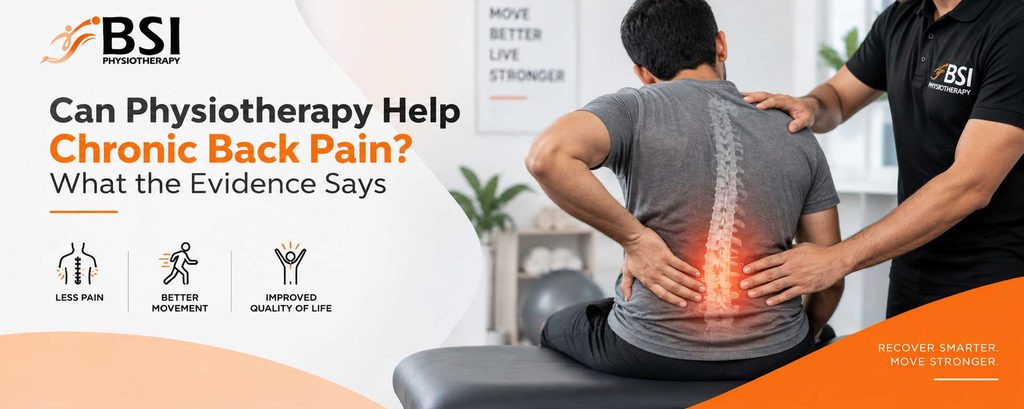
Chronic back pain can affect almost every part of daily life—from sitting at work and driving to exercising, sleeping and performing routine activities.
If you’ve been dealing with back pain for months, you may wonder whether physiotherapy can actually help or whether you simply need to live with the discomfort.
The good news is that physiotherapy can be an important part of managing many types of chronic low back pain, particularly when treatment combines education, appropriate exercise, gradual activity and strategies for self-management.
The World Health Organization (WHO) recommends non-surgical approaches such as education, exercise and certain physical therapies as part of care for adults with chronic primary low back pain.
What Is Chronic Back Pain?
Back pain is generally described as chronic when it persists for more than three months.
Chronic low back pain can have many contributing factors. In many cases, it isn’t possible to identify one specific structure as the sole cause of pain.
WHO notes that non-specific low back pain is the most common presentation, accounting for around 90% of cases.
This is one reason why managing chronic back pain often involves more than treating one particular area of the spine.
A rehabilitation approach may consider:
- Movement
- Muscle strength
- Physical activity
- Work demands
- Sleep
- Lifestyle factors
- Previous injuries
- Fear or avoidance of movement
- Individual goals
Can Physiotherapy Really Help Chronic Back Pain?
Yes, physiotherapy can help many people manage chronic back pain.
However, physiotherapy isn’t a single treatment. It is a broad field that includes assessment, education, exercise-based rehabilitation, movement training and other interventions.
The WHO’s chronic low back pain guideline supports structured exercise programmes and other non-surgical approaches as part of person-centred care.
The goal isn’t necessarily to promise that every patient will become completely pain-free.
Instead, rehabilitation may aim to help you:
- Reduce the impact of pain
- Improve movement
- Build strength
- Increase physical activity
- Improve confidence with movement
- Return to work or exercise
- Manage future flare-ups
- Improve overall function
What Does the Evidence Say About Exercise?
Exercise is one of the important components of rehabilitation for chronic low back pain.
WHO recommends that a structured exercise therapy or programme may be offered to adults with chronic primary low back pain. The guideline notes that programmes tailored to the individual’s clinical profile and supported by appropriate supervision and adherence can be beneficial.
Exercise does not necessarily mean intense gym workouts.
Depending on your condition and goals, a physiotherapist may use:
- Core strengthening
- Hip strengthening
- Mobility exercises
- Aerobic activity
- Resistance training
- Functional exercises
- Balance exercises
- Gradual loading
- Movement retraining
The right exercise programme depends on the individual.
Does Physiotherapy Mean You Should Avoid Moving Your Back?
Usually, the goal is not to permanently protect your back from movement.
WHO recommends physical activity and self-management as important components of low back pain care.
Some people with chronic back pain become cautious about bending, lifting, walking or exercising because they are worried about making their condition worse.
A physiotherapist can help determine which movements are appropriate and how to gradually increase activity.
The objective is controlled progression, rather than forcing painful movements or avoiding all activity.
What About Manual Therapy and Massage?
Manual therapy can be used in some physiotherapy programmes, but it shouldn’t necessarily be viewed as the entire treatment.
NICE recommends considering manual therapy such as mobilisation, manipulation or soft-tissue techniques as part of a treatment package that includes exercise, rather than as an isolated treatment.
This is an important distinction.
A session may include hands-on treatment to help with symptoms or movement, followed by exercises and advice that help you develop longer-term physical capacity.
Why Is Strength Training Important?
When back pain persists, people may reduce their physical activity.
Over time, this can contribute to reduced strength and physical capacity.
A progressive strengthening programme can help you gradually rebuild your ability to perform activities such as:
- Walking
- Climbing stairs
- Lifting
- Bending
- Sitting and standing
- Exercising
- Sports participation
The programme should be adjusted according to your current abilities rather than based on a one-size-fits-all exercise list.
Can Physiotherapy Help if Back Pain Keeps Coming Back?
It can.
Repeated episodes of back pain can be frustrating, particularly when symptoms improve and then return after normal activity.
A rehabilitation programme can focus not only on the current symptoms but also on improving your ability to tolerate everyday physical demands.
Your physiotherapist may assess:
- Strength
- Mobility
- Movement patterns
- Exercise tolerance
- Work-related activities
- Training load
- Previous injuries
- Lifestyle factors
The aim is to help you develop a sustainable approach to managing your back rather than relying only on short-term symptom relief.
What If Sitting at Work Makes My Back Pain Worse?
This is particularly relevant for people who spend long hours at a desk.
WHO identifies workplace ergonomic adjustments, physical activity and staying engaged in work and social activities as part of self-care strategies for low back pain.
A physiotherapist may help you look at:
- Sitting habits
- Desk setup
- Break frequency
- Movement throughout the working day
- Exercise routine
- Work-related lifting or physical demands
The objective isn’t necessarily to find one “perfect posture.”
Instead, the focus may be on improving movement variety, physical capacity and tolerance for your daily activities.
How Long Does Physiotherapy Take to Help Chronic Back Pain?
There is no fixed timeline.
Chronic back pain can behave differently from person to person, so rehabilitation should be monitored and adjusted according to progress.
Factors that can influence recovery include:
- Duration of symptoms
- Severity of symptoms
- Physical activity levels
- Strength and mobility
- Sleep
- Work demands
- Previous episodes of back pain
- Exercise adherence
- Individual goals
Rather than focusing only on the number of physiotherapy sessions, it can be more useful to track functional improvements.
For example:
Can you sit longer?
Can you walk further?
Can you exercise more comfortably?
Can you lift objects with greater confidence?
These changes can be meaningful indicators of progress.
Do You Need an MRI for Chronic Back Pain?
Not necessarily.
NICE recommends that imaging should not routinely be offered in non-specialist settings for low back pain with or without sciatica. Imaging may be considered in specialist settings when the result is likely to change management.
An assessment should therefore come before assuming that an MRI is automatically required.
If your symptoms suggest a condition requiring medical investigation, a healthcare professional can guide you toward appropriate evaluation.
When Should You See a Doctor Instead of Only Starting Physiotherapy?
Most back pain does not require urgent medical treatment, but certain symptoms require appropriate medical assessment.
Seek prompt medical attention if back pain is accompanied by concerning symptoms such as:
- Significant or progressive weakness
- New problems with bladder or bowel control
- Numbness around the groin or saddle area
- Major trauma
- Fever or signs of significant infection
- Unexplained significant weight loss
- Severe or rapidly worsening symptoms
These symptoms should not simply be managed with routine exercise without appropriate medical evaluation.
Physiotherapy in Bangalore for Chronic Back Pain
If you’re searching for physiotherapy in Bangalore for chronic back pain, the first step should be understanding what may be contributing to your symptoms and how they affect your daily activities.
At BSI Physiotherapy, rehabilitation can be tailored according to your symptoms, movement, strength, activity level and functional goals.
Depending on the assessment, your programme may include:
- Therapeutic exercise
- Strength training
- Mobility work
- Movement retraining
- Manual therapy where appropriate
- Activity modification
- Education and self-management strategies
- Progressive return to exercise or sport
The objective is not simply to provide temporary relief. Rehabilitation aims to help you build the physical capacity and confidence needed to manage your condition and return to meaningful activities.
Frequently Asked Questions
Can physiotherapy cure chronic back pain?
Physiotherapy cannot guarantee a complete cure because chronic back pain can have different causes and contributing factors. However, rehabilitation can help many people improve function, physical capacity and their ability to manage symptoms.
What exercises are best for chronic back pain?
There is no single exercise that is best for everyone. A suitable programme may include strengthening, mobility, aerobic activity and functional exercises depending on the person’s condition and goals.
Should I rest if I have chronic back pain?
Long periods of inactivity are generally not the goal of chronic back pain management. Staying physically active within appropriate limits is an important part of self-management.
Is massage enough for chronic back pain?
Massage or other manual techniques may provide symptom relief for some people, but current guidelines support using manual therapy as part of a broader programme that includes exercise and self-management.
Can physiotherapy help back pain caused by sitting all day?
Physiotherapy may help address factors such as reduced physical activity, strength, movement tolerance and work-related habits. Your physiotherapist can help develop strategies appropriate for your work routine.
How do I choose a physiotherapy clinic in Bangalore?
Look for a clinic where your condition is assessed individually and where the rehabilitation programme is based on your symptoms, goals and functional needs rather than relying on a standard treatment plan.
Final Takeaway
Chronic back pain doesn’t necessarily mean you have to stop being active or accept ongoing limitations.
Current guidance supports a person-centred, non-surgical approach that can include education, structured exercise and appropriate physical therapies.
Physiotherapy can be one part of that approach, particularly when the programme is designed around your individual needs.
If you’re experiencing persistent back pain, consider getting an assessment to understand your symptoms and identify an appropriate path toward improving movement, strength and function.
Looking for physiotherapy in Bangalore? BSI Physiotherapy provides assessment and rehabilitation for back pain, orthopaedic conditions and sports-related problems.
Medical note: This article is for general educational purposes and does not replace an individual medical or physiotherapy assessment. Persistent or severe symptoms should be evaluated by an appropriate healthcare professional.