An anterior cruciate ligament (ACL) injury is one of the common knee injuries experienced by athletes and physically active individuals. It frequently occurs during activities involving sudden direction changes, pivoting, jumping and landing.
For individuals with significant ACL injuries, particularly those experiencing knee instability or wishing to return to demanding sports, ACL reconstruction surgery may be recommended following an orthopaedic evaluation.
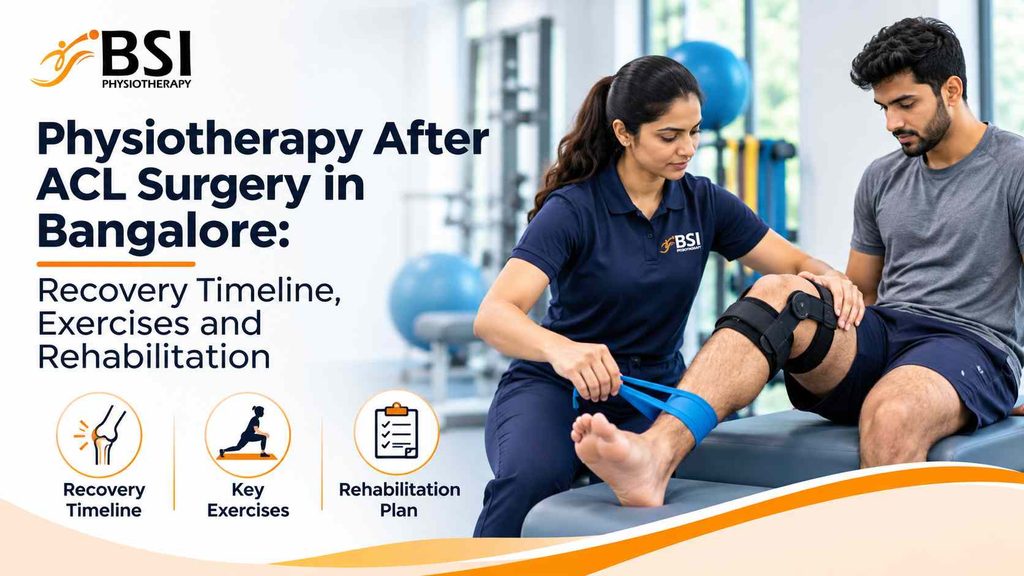
However, surgery is only one part of the recovery process. Physiotherapy after ACL surgery plays an essential role in restoring knee movement, rebuilding muscle strength, improving balance and preparing patients to return to their daily activities and sports.
If you are looking for ACL rehabilitation or postoperative physiotherapy in Bangalore, understanding the recovery timeline can help you prepare for the rehabilitation journey.
This guide explains the different stages of ACL recovery, commonly recommended rehabilitation exercises and what to consider when choosing the right physiotherapy clinic.
Why Is Physiotherapy Important After ACL Surgery?
The ACL helps stabilise the knee joint, particularly during movements involving rotation, pivoting and sudden changes in direction.
After ACL reconstruction, patients may experience:
- Knee pain and swelling.
- Reduced knee bending and straightening.
- Quadriceps muscle weakness.
- Difficulty walking normally.
- Reduced balance and coordination.
- Difficulty climbing stairs.
- Reduced confidence during physical activity.
Postoperative physiotherapy aims to address these limitations through a progressive rehabilitation programme.
The main goals include:
- Managing postoperative swelling and discomfort.
- Restoring knee range of motion.
- Regaining quadriceps and hamstring strength.
- Improving balance and neuromuscular control.
- Restoring walking and functional movement.
- Preparing for running and sport-specific activities.
- Supporting a safe return to sports when appropriate.
Rehabilitation should be individualised according to the surgical procedure, graft type, associated injuries, medical advice and individual progress.
ACL Surgery in Bangalore Recovery Timeline: What to Expect
ACL rehabilitation in Bangalore is generally divided into different stages. However, recovery does not follow an identical timeline for everyone.
The following is a general overview. Your surgeon and physiotherapist should determine when you can progress to each stage.
Phase 1: Immediate Postoperative Recovery (Week 0–2)
The initial phase focuses on protecting the reconstructed ligament, managing swelling and beginning safe movement.
Common rehabilitation goals include:
- Reducing knee swelling.
- Restoring full knee extension as advised.
- Gradually improving knee bending.
- Activating the quadriceps muscles.
- Improving safe walking with appropriate support.
Exercises may include:
Ankle Pumps: Gentle ankle movements to encourage circulation.
Quadriceps Sets: Contracting the thigh muscles without moving the knee.
Heel Slides: Gradually bending the knee within the permitted range.
Straight Leg Raises: Performed when adequate quadriceps control is achieved and there is no significant extension lag.
Weight-bearing and knee movement restrictions may differ depending on the surgical procedure and associated injuries.
Phase 2: Restoring Mobility and Muscle Activation (Weeks 2–6)
During this phase, rehabilitation focuses on improving knee mobility, strengthening the surrounding muscles and progressing functional activities.
Common rehabilitation components include:
- Progressive knee range-of-motion exercises.
- Quadriceps strengthening.
- Hamstring and hip muscle strengthening.
- Stationary cycling when appropriate.
- Gait retraining.
- Basic balance exercises.
The physiotherapist monitors knee swelling, movement quality and muscle activation before progressing the programme.
The aim is to improve walking and everyday function without increasing symptoms.
Phase 3: Strength Development and Functional Training (Weeks 6–12)
As the knee progresses through the early healing stages, rehabilitation increasingly focuses on rebuilding strength and improving movement control.
Common exercises may include:
- Squats within an appropriate range.
- Step-ups and step-downs.
- Resistance-based strengthening.
- Hip strengthening.
- Single-leg balance exercises.
- Controlled functional movements.
The focus is on improving lower-limb strength and control while maintaining appropriate exercise progression.
Not every patient will be ready for the same exercises at the same time. Associated meniscus repairs or other procedures may require additional restrictions.
Phase 4: Advanced Strengthening and Running Preparation (Months 3–5)
This stage focuses on developing the physical capacity needed for higher-level activities.
Depending on clinical progress, the rehabilitation programme may include:
- Progressive resistance training.
- Single-leg strengthening.
- Dynamic balance training.
- Landing mechanics.
- Controlled jumping exercises.
- Running preparation.
Running should only begin when the patient meets appropriate clinical and functional criteria and receives clearance from the treating team.
The number of months after surgery alone should not determine readiness.
Phase 5: Return-to-Sport Rehabilitation (Months 5–9 and Beyond)
Returning to competitive sports requires more than recovering knee movement or reducing pain.
Athletes need adequate strength, stability, coordination and confidence to manage the demands of their sport.
Rehabilitation may include:
- Progressive running drills.
- Acceleration and deceleration training.
- Jumping and landing exercises.
- Agility and change-of-direction drills.
- Sport-specific movement training.
- Functional performance testing.
Many athletes require nine months or longer before considering a return to demanding pivoting sports. Some need additional time depending on their recovery, strength and functional testing results.
A return-to-sport decision should be made collaboratively by the surgeon, physiotherapist and athlete.
5 Important Factors That Influence ACL Recovery
Recovery following ACL reconstruction depends on several individual factors.
1. Type of Surgical Procedure
ACL reconstruction may involve different graft choices, including hamstring tendon, patellar tendon or quadriceps tendon grafts.
Associated procedures, such as meniscus repair, can also affect rehabilitation restrictions.
2. Muscle Strength
Quadriceps and hamstring strength are important for knee stability and functional movement.
Regaining adequate strength is a major rehabilitation goal.
3. Knee Swelling and Mobility
Persistent swelling and restricted knee movement may affect muscle activation and walking ability.
These factors should be regularly monitored during rehabilitation.
4. Consistency With Physiotherapy
Following an appropriate rehabilitation programme and attending scheduled reassessments can help patients progress safely.
Home exercises should be performed according to the physiotherapist’s instructions.
5. Psychological Readiness
Fear of reinjury and reduced confidence can affect an athlete’s ability to return to sports.
Gradual exposure to sport-specific activities and appropriate psychological support may help address these concerns.
Common Mistakes to Avoid After ACL Surgery
Some patients unintentionally delay their recovery by progressing activities too quickly or ignoring rehabilitation guidance.
Avoid these common mistakes:
- Returning to running before meeting rehabilitation criteria.
- Skipping prescribed strengthening exercises.
- Ignoring persistent swelling or increasing pain.
- Comparing your recovery with another patient’s timeline.
- Returning to competitive sports based only on pain reduction.
- Performing high-impact exercises without appropriate clearance.
- Ignoring the surgeon’s postoperative restrictions.
Seek medical advice if you experience significant worsening pain, increasing swelling, fever, wound-related concerns or new calf pain and swelling. Sudden breathlessness or chest pain requires emergency medical attention.
How to Choose the Best Physiotherapy Clinic in Bangalore for ACL Rehabilitation?
Choosing the right rehabilitation centre is an important part of postoperative recovery.
If you are searching for the Best Physiotherapy Clinic in Bangalore, consider the following factors:
1. Experience in ACL Rehabilitation: Look for physiotherapists familiar with postoperative knee rehabilitation and return-to-sport programmes.
2. Proper Clinical Assessment: The clinic should assess knee movement, swelling, muscle strength, balance and functional limitations.
3. Individualised Rehabilitation: Treatment should follow your surgeon’s recommendations and be adjusted according to your recovery.
4. Strength and Conditioning Facilities: Appropriate resistance and functional training equipment can support progressive strengthening.
5. Return-to-Sport Assessment: Athletes should have access to appropriate strength, balance and functional performance assessments.
6. Regular Progress Monitoring: Your physiotherapist should reassess your recovery and modify exercises when necessary.
7. Communication With Your Surgeon: Coordination between the surgeon and physiotherapist is important, especially when additional procedures have been performed.
Rather than choosing a clinic based only on equipment or advertising claims, prioritise clinical expertise, appropriate rehabilitation protocols and individual patient care.
Why Choose BSI Physiotherapy in Bangalore?
BSI Physiotherapy provides orthopaedic rehabilitation, sports physiotherapy and postoperative rehabilitation services for individuals recovering from injuries and surgical procedures.
The clinic focuses on restoring physical function, rebuilding strength and helping individuals work towards their rehabilitation goals through structured physiotherapy programmes.
BSI’s relevant services include:
Post-Surgical Rehabilitation: Individualised rehabilitation programmes following orthopaedic procedures, including ACL reconstruction.
Sports Physiotherapy: Rehabilitation for sports-related injuries and preparation for returning to physical activity.
Strength and Conditioning: Progressive strengthening programmes to improve muscle function, stability and physical capacity.
Sports Injury Rehabilitation: Management of ligament injuries, muscle strains and other sports-related conditions.
Gait and Movement Assessment: Evaluation of movement patterns and functional limitations to guide rehabilitation.
Orthopaedic Physiotherapy: Rehabilitation for knee, shoulder, spine and other musculoskeletal conditions.
BSI’s physiotherapy team includes professionals with experience in sports and orthopaedic rehabilitation.
The rehabilitation approach considers the patient’s surgical history, current physical condition, movement limitations and recovery goals.
Located in Bangalore, BSI Physiotherapy has clinics serving patients in Marathahalli, Jayanagar and Whitefield.
For individuals recovering from ACL reconstruction, rehabilitation may involve progressive knee mobility exercises, muscle strengthening, balance training and functional activities, depending on the surgeon’s instructions and clinical assessment.
Whether you are an athlete preparing to return to sports or an individual working towards comfortable everyday movement, BSI Physiotherapy can help assess your rehabilitation requirements.
Frequently Asked Questions About Physiotherapy After ACL Surgery
1. How long does physiotherapy take after ACL surgery?
ACL rehabilitation commonly continues for nine months or longer, particularly for athletes returning to pivoting sports. The duration depends on surgical details, recovery progress and functional readiness.
2. When can I start walking after ACL surgery?
Some patients begin walking with appropriate support soon after surgery. However, weight-bearing restrictions may vary depending on the surgical procedure and associated injuries. Follow your surgeon’s instructions.
3. When can I start running after ACL reconstruction?
Running may be introduced during the later stages of rehabilitation when appropriate strength, movement and functional criteria are achieved. The timing must be determined by the treating team.
4. Can I return to sports after ACL surgery?
Many patients successfully return to sports after ACL reconstruction. However, returning safely requires adequate strength, movement control, functional testing and medical clearance.
5. Is physiotherapy necessary after ACL reconstruction?
Yes. Physiotherapy is a central component of ACL rehabilitation. It helps restore mobility, muscle strength, balance and functional capacity following surgery.
6. Where can I get ACL rehabilitation in Bangalore?
BSI Physiotherapy provides sports and orthopaedic rehabilitation services at its Bangalore clinics in Marathahalli, Jayanagar and Whitefield. Contact the clinic to enquire about postoperative rehabilitation appointments.
Start Your ACL Rehabilitation Journey With BSI Physiotherapy
ACL reconstruction is an important step towards addressing knee instability, but structured rehabilitation is essential for restoring strength, movement and physical function.
A well-planned physiotherapy programme can help patients progress through different recovery stages while monitoring their response to exercise and functional training.
If you are searching for the Best Physiotherapy Clinic in Bangalore for ACL rehabilitation, BSI Physiotherapy offers sports physiotherapy, orthopaedic rehabilitation and postoperative recovery services.
Contact BSI Physiotherapy to discuss your ACL rehabilitation requirements and take the next step towards recovery.
BSI Physiotherapy – Bangalore
Website: https://www.bsiphysiotherapy.com/
Locations: Marathahalli | Jayanagar | Whitefield, Bangalore.
Medical disclaimer: This article is intended for general educational purposes and does not replace individual medical advice. ACL rehabilitation must be guided by the treating surgeon and a qualified physiotherapist based on the surgical procedure and individual recovery.