
Rotator Cuff Injury Physiotherapy in Bangalore: Treatment, Exercises and Recovery
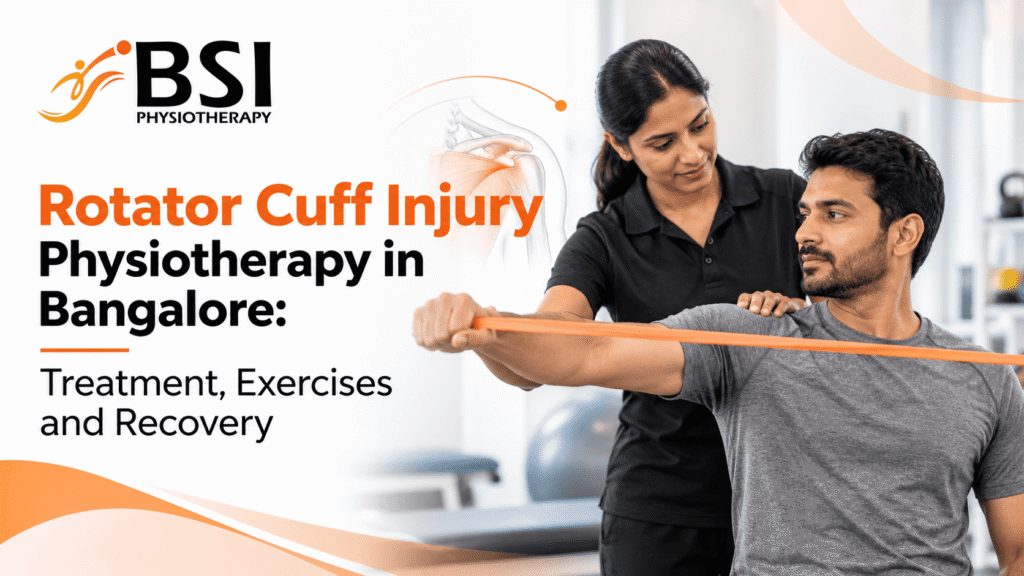
Shoulder pain, weakness while lifting your arm, and discomfort during everyday activities may be signs of a rotator cuff injury. These symptoms can affect your ability to work, exercise, play sports, or sleep comfortably.
The rotator cuff is a group of four muscles and their tendons that help stabilise the shoulder joint and control arm movements. Injuries involving these structures can develop gradually because of repetitive activities or occur suddenly following a fall, sports injury, or heavy lifting.
Rotator cuff injury physiotherapy in Bangalore can help many people improve shoulder movement, build strength, manage symptoms, and return to daily activities. However, treatment depends on the type and severity of the injury, the patient’s functional requirements, and whether a significant tendon tear is present.
At BSI Physiotherapy, rehabilitation focuses on assessing shoulder function and developing an individualised programme to support recovery and improve movement.
What Is a Rotator Cuff Injury?
The rotator cuff consists of four muscles and their associated tendons:
● Supraspinatus: Helps lift the arm away from the body.
● Infraspinatus: Helps rotate the arm outward.
● Teres minor: Assists external rotation and shoulder stability.
● Subscapularis: Helps rotate the arm inward and stabilise the shoulder.
These structures work together to keep the upper arm bone centred in the shoulder socket
while the arm moves.
A rotator cuff injury can involve tendon irritation, tendinopathy, a partial tear, or a complete
tear. Some injuries develop through gradual tendon changes, while others follow a sudden
traumatic event.
Understanding the type of injury helps determine whether physiotherapy alone is appropriate
or whether further medical assessment is necessary.
What Causes Rotator Cuff Injuries?
Several factors can contribute to rotator cuff problems.
1. Repetitive Overhead Activities
Activities such as swimming, throwing, painting, lifting objects overhead, and certain gym
exercises place repeated demands on the shoulder.
When activity increases faster than the shoulder’s capacity to tolerate it, symptoms may
develop.
2. Sports Injuries
Athletes participating in cricket, badminton, tennis, swimming, and throwing sports may
experience rotator cuff-related pain due to repetitive shoulder loading or sudden injury.
Appropriate rehabilitation may help restore strength, endurance, and control before returning
to sport.
3. Age-Related Tendon Changes
Rotator cuff tendons can undergo structural changes with age. These changes do not
always cause pain, but they may contribute to symptoms or increase the likelihood of a tear
in some individuals.
Treatment decisions should consider symptoms, shoulder function, injury history, and clinical
findings rather than imaging alone.
4. Sudden Injury or Trauma
A fall onto the arm, a sudden pulling movement, or lifting a heavy object unexpectedly can
injure the rotator cuff.
Sudden pain accompanied by substantial weakness or difficulty raising the arm warrants
prompt medical assessment because a significant tear may be present.
5. Poorly Managed Training Loads
Sudden increases in resistance training, repetitive overhead exercises, or inadequate
recovery between demanding activities may contribute to shoulder symptoms.
The solution is not necessarily to stop exercising completely. Adjusting the load and
gradually rebuilding shoulder capacity may be more appropriate, depending on the injury.
What Are the Symptoms of a Rotator Cuff Injury?
Symptoms vary according to the structures involved and the severity of the injury.
Common symptoms include:
● Pain when raising the arm overhead.
● Discomfort when lifting or carrying objects.
● Pain when lying on the affected shoulder.
● Weakness during shoulder rotation or lifting.
● Difficulty reaching behind the back.
● Reduced ability to participate in sports or gym activities.
● Pain that increases during repetitive arm movements.
Some people experience pain without significant weakness, while others with larger tears
may have considerable difficulty lifting the arm.
These symptoms can overlap with frozen shoulder, subacromial pain, arthritis, and other
conditions. A clinical assessment is needed to establish the likely cause.
Types of Rotator Cuff Tears
Rotator cuff injuries are commonly described according to the extent of tendon damage.
Partial-Thickness Tear
A partial tear affects part of the tendon thickness without completely separating the tendon.
Depending on the symptoms and clinical findings, treatment may involve activity
modification, progressive strengthening, and other rehabilitation strategies.
Full-Thickness Tear
A full-thickness tear extends through the entire thickness of the tendon. Some tears remain
relatively small, while others involve larger areas or multiple tendons.
Treatment depends on the size and location of the tear, the degree of weakness, the
person’s activity goals, and whether the injury occurred suddenly.
Some patients can improve with non-surgical management. Others, particularly those with
significant traumatic tears or substantial functional loss, may need an orthopaedic
consultation to discuss surgical options.
How Is a Rotator Cuff Injury Diagnosed?
A physiotherapist or orthopaedic specialist will assess your symptoms and shoulder function
to determine the appropriate next step.
Clinical Assessment
The assessment may include:
● Reviewing when and how the pain started.
● Checking shoulder movement and flexibility.
● Assessing rotator cuff strength where appropriate.
● Evaluating shoulder blade movement and control.
● Identifying activities that aggravate symptoms.
● Reviewing previous injuries and relevant medical history.
Imaging Tests
Imaging may be recommended when the findings suggest a significant tear or when the
result could change the treatment plan.
Depending on the situation, investigations may include:
● Ultrasound: Can assess rotator cuff tendons and identify certain tendon tears.
● MRI: Provides detailed information about tendons and other shoulder structures.
● X-ray: Helps assess bones and joint changes but does not directly show rotator cuff
tendons.
Not everyone with shoulder pain requires imaging. The decision should be based on the
clinical assessment and the suspected injury.
How Can Physiotherapy Help a Rotator Cuff Injury?
Physiotherapy can help many people with rotator cuff-related shoulder pain by improving
movement, restoring strength, and increasing tolerance for everyday activities.
The rehabilitation plan depends on whether the problem involves tendon irritation, a partial
tear, a larger tear being managed without surgery, or recovery following an operation.
1. Pain Management and Activity Modification
Early rehabilitation may focus on reducing aggravating activities while maintaining
appropriate shoulder movement.
Your physiotherapist may recommend temporarily modifying heavy overhead lifting,
adjusting gym exercises, or reducing repetitive movements that worsen symptoms.
The aim is to find a manageable activity level rather than unnecessarily avoiding all shoulder
movement.
2. Restoring Shoulder Mobility
Pain may cause people to move their shoulder less, contributing to stiffness and reduced
function.
When appropriate, treatment may include gentle assisted movement, range-of-motion
exercises, and carefully progressed mobility work.
Exercises should be selected according to the injury. A person with a significant acute tear
may require a different approach from someone with gradual tendon-related pain.
3. Rotator Cuff Strengthening
Progressive strengthening helps improve the shoulder’s ability to tolerate daily and sporting
demands.
Depending on the assessment, exercises may target external rotation, internal rotation,
shoulder elevation, and the muscles supporting the shoulder blade.
Resistance should be introduced gradually and adjusted according to pain, strength, and
recovery.
4. Shoulder Blade Control
The shoulder blade works together with the shoulder joint during arm movement.
Rehabilitation may therefore include exercises that improve the strength and coordination of
the muscles around the shoulder blade.
The purpose is to support effective arm movement and improve overall shoulder function,
rather than to force the shoulder into one supposedly perfect posture.
5. Functional and Sports-Specific Rehabilitation
As symptoms and strength improve, exercises can progress towards the activities that
matter to the patient.
These may include lifting, reaching overhead, gym training, swimming, throwing, or racket
sports.
Athletes may require additional assessment of strength, endurance, movement control, and
sport-specific performance before returning to full training.
Rotator Cuff Injury Exercises
The following exercises are examples sometimes used in rotator cuff rehabilitation. They are not suitable for every injury, and the appropriate starting point depends on your symptoms and clinical assessment.
1. Pendulum Exercise
This exercise may help maintain gentle shoulder movement when appropriate.
How to perform it:
1. Lean forward while supporting yourself with your unaffected hand on a stable surface.
2. Allow the affected arm to hang comfortably.
3. Gently shift your body to create small arm movements.
4. Keep the shoulder relaxed and avoid forcing the movement.
2. Isometric External Rotation
Isometric exercises involve producing muscle tension without noticeable joint movement. They may be appropriate for some people with shoulder pain.
How to perform it:
1. Keep your elbow bent and close to your side.
2. Place the back of your hand against a wall or another stable surface.
3. Gently press outward without allowing the arm to move.
4. Hold briefly, then relax.
Use only light effort and perform the exercise if it is comfortable and appropriate for your condition.
3. Resistance-Band External Rotation
This exercise may be introduced when strengthening is appropriate.
How to perform it:
1. Secure a light resistance band at a suitable height.
2. Keep your elbow bent and close to your body.
3. Slowly rotate your forearm outward against the resistance.
4. Return to the starting position with control.
Start with light resistance and avoid compensating by twisting your trunk or moving your
elbow away from your side.
4. Shoulder Blade Strengthening
Your physiotherapist may prescribe controlled shoulder blade exercises to improve
coordination and muscular endurance.
The exercise selection and progression should reflect your movement limitations and
recovery stage.
Exercise safety: Stop if an exercise causes sharp pain, significantly worsens your
symptoms, or produces new weakness or numbness. If you have a suspected significant
tear or have recently undergone surgery, seek professional guidance before starting these
exercises.
Rotator Cuff Physiotherapy After Surgery
Some rotator cuff tears require surgical repair, particularly when the injury, functional
demands, and clinical findings indicate that surgery may be beneficial.
Physiotherapy is an important part of recovery following many shoulder operations, but
rehabilitation must respect the healing tendon.
Phase 1: Protection
The early phase focuses on protecting the repair and following prescribed movement
restrictions. A sling may be required for a period determined by the surgeon.
Phase 2: Regaining Movement
When permitted, rehabilitation gradually introduces assisted and active movement to restore
mobility.
Phase 3: Progressive Strengthening
Strengthening begins when the repair and the prescribed protocol allow it. Resistance and
exercise difficulty increase gradually.
Phase 4: Functional Rehabilitation
Later rehabilitation focuses on improving strength, endurance, lifting ability, and readiness
for work or sports.
These phases do not follow a universal timetable. The pace depends on the size of the tear,
the surgical procedure, tissue healing, and the surgeon’s instructions.
How Long Does Recovery From a Rotator Cuff Injury Take?
Recovery varies according to the injury, treatment approach, symptom severity, and the
individual’s activity demands.
| Type of injury or treatment | General recovery considerations |
|---|---|
| Mild tendon-related shoulder pain | May improve over several weeks with appropriate management. |
| Partial-thickness tear | Recovery may take several weeks to months, depending on severity and function. |
| Larger tear managed without surgery | Improvement varies; persistent weakness may require specialist review. |
| Rotator cuff repair surgery | Rehabilitation commonly takes several months, with full recovery depending on the repair and individual progress. |
| Return to overhead sports | Requires adequate strength, movement, endurance, and sport-specific readiness. |
These are broad expectations rather than guaranteed timelines. Progress should be
monitored through changes in pain, movement, strength, and functional ability.
Can a Rotator Cuff Tear Heal Without Surgery?
Some people with rotator cuff tears improve with non-surgical treatment, including
physiotherapy and appropriate activity modification.
However, symptom improvement does not necessarily mean that a torn tendon has
structurally healed. Physiotherapy may help improve shoulder function even when a tear
remains present.
Whether surgery is appropriate depends on factors such as:
● The size and location of the tear.
● Whether the injury was sudden or gradual.
● The degree of weakness and functional limitation.
● The patient’s age and activity requirements.
● Response to non-surgical treatment.
● The specialist’s assessment of the tendon and overall shoulder.
A sudden injury with substantial weakness should be assessed promptly rather than
managed with an unsupervised exercise programme.
When Should You See a Physiotherapist?
Consider consulting a qualified physiotherapist if you experience:
● Persistent shoulder pain during lifting or reaching.
● Difficulty raising your arm overhead.
● Reduced strength during everyday activities.
● Shoulder pain that interferes with sleep.
● Recurrent symptoms during gym training or sports.
● Difficulty regaining movement after an injury or surgery.
Seek prompt medical assessment after a significant shoulder injury, especially if you have
sudden marked weakness or cannot raise your arm. A deformed shoulder or inability to
move the arm following trauma requires urgent evaluation.
Rotator Cuff Injury Physiotherapy at BSI Physiotherapy, Bangalore
Rotator cuff problems can interfere with work, sleep, exercise, and sporting performance.
Appropriate assessment and rehabilitation can help many patients improve shoulder function
and return to their usual activities.
At BSI Physiotherapy in Bangalore, rehabilitation can be tailored to the patient’s
symptoms, shoulder movement, strength, activity demands, and recovery goals.
Depending on the condition, treatment may include:
● Individualised shoulder assessment.
● Progressive rotator cuff strengthening.
● Shoulder mobility and movement-control exercises.
● Sports injury rehabilitation.
● Functional retraining.
● Postoperative rehabilitation in accordance with the surgeon’s protocol.
The goal is to develop a structured recovery plan that supports better movement and helps
patients gradually return to their daily routines.
If you are experiencing shoulder pain, weakness, or difficulty lifting your arm, consider
arranging an assessment with a qualified physiotherapist.
Looking for rotator cuff injury physiotherapy in Bangalore?
Contact BSI Physiotherapy to discuss your symptoms and determine the next appropriate
step in your rehabilitation.
Website: https://www.bsiphysiotherapy.com/
Frequently Asked Questions
1. Can physiotherapy treat a rotator cuff injury?
Yes. Physiotherapy can help many rotator cuff-related conditions by improving shoulder
strength, movement, and function. The appropriate treatment depends on the type and
severity of the injury.
2. What is the best exercise for a rotator cuff injury?
There is no single best exercise for every rotator cuff injury. Depending on the assessment,
rehabilitation may include external rotation strengthening, isometric exercises, mobility work,
and shoulder blade strengthening.
3. Can a rotator cuff tear heal without surgery?
Some patients improve function with non-surgical treatment, but a torn tendon does not
necessarily heal structurally. Treatment decisions depend on the tear, symptoms, weakness,
activity goals, and specialist assessment.
4. How do I know if my rotator cuff is torn?
Symptoms may include shoulder pain, weakness, and difficulty lifting your arm. However,
these symptoms can occur with other shoulder conditions. A clinical assessment and, when
indicated, imaging can help establish the diagnosis.
5. How long does rotator cuff physiotherapy take?
The duration depends on the severity of the injury and the treatment approach. Some
tendon-related problems improve over several weeks, while significant tears and
postoperative rehabilitation may require several months or longer.
6. Can I go to the gym with a rotator cuff injury?
You may be able to continue selected activities with appropriate modifications, but painful
overhead lifting and exercises that significantly aggravate symptoms may need to be
reduced temporarily. Seek guidance before continuing heavy training, especially if you have
substantial weakness.
7. Is physiotherapy necessary after rotator cuff surgery?
Rehabilitation is commonly an essential part of recovery following rotator cuff repair. The
exercises and progression must follow the surgeon’s protocol to protect the healing tendon.
Conclusion
Rotator cuff injuries can cause shoulder pain, weakness, and difficulty raising or rotating the
arm. Depending on the injury, treatment may involve activity modification, physiotherapy,
further medical investigation, or surgery.
A suitable rehabilitation programme can help many people improve shoulder strength, movement, and daily function. Early assessment is particularly important when symptoms begin after trauma or are accompanied by significant weakness.
If you are looking for rotator cuff injury physiotherapy in Bangalore, BSI Physiotherapy can be a starting point for discussing your symptoms and exploring appropriate rehabilitation options.
Medical disclaimer: This article is for educational purposes only and does not replace an individual clinical assessment, diagnosis, or medical advice.