
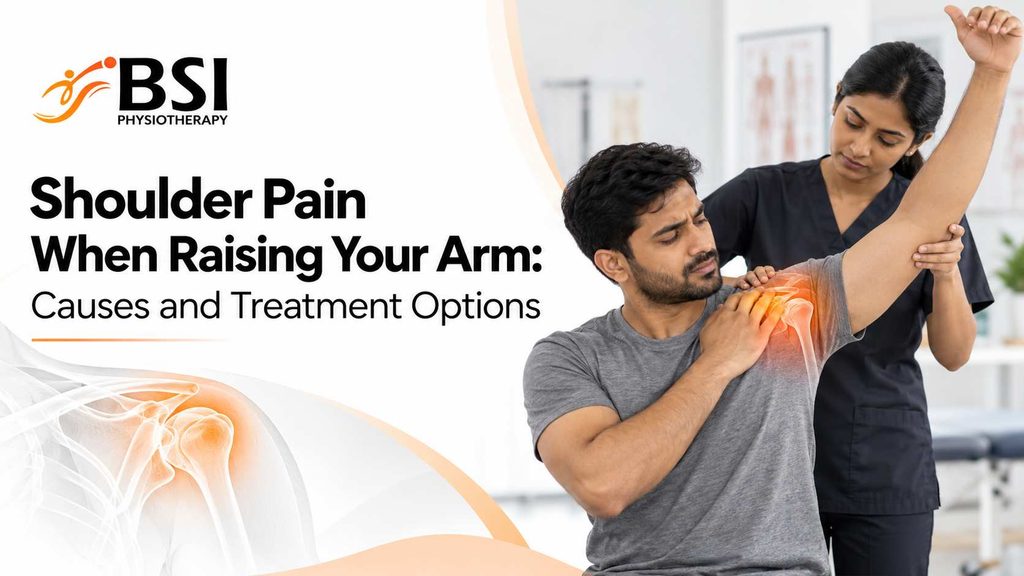
Shoulder pain when raising your arm is a common problem that can make everyday
activities such as reaching overhead, getting dressed, lifting objects, or exercising difficult.
The pain may occur when you lift your arm to the front, move it sideways, or reach behind
your back.
Some people experience a mild ache that gradually develops over time, while others notice
sudden pain after a sports injury, lifting a heavy object, or making an awkward movement.
The cause of shoulder pain can vary from tendon irritation and muscle strain to frozen
shoulder or a rotator cuff injury. Identifying the underlying problem is important for choosing
the right treatment.
At BSI Physiotherapy in Bangalore, shoulder rehabilitation focuses on assessing
movement difficulties, improving shoulder strength and mobility, and helping patients return
to their everyday activities through an individualised treatment plan.
Why Does My Shoulder Hurt When I Raise My Arm?
Your shoulder is a complex joint that relies on muscles, tendons, ligaments, and coordinated
movement of the shoulder blade to allow your arm to move freely.
Pain during arm elevation can develop when these structures become irritated, injured, stiff,
or less able to tolerate the demands placed on them.
Common causes include:
● Rotator cuff-related shoulder pain.
● Shoulder impingement or subacromial pain.
● Frozen shoulder.
● Rotator cuff tears.
● Shoulder bursitis.
● Muscle strain or sports-related injuries.
● Shoulder instability or previous dislocation.
● Arthritis affecting the shoulder joint.
The location of the pain, the movements that trigger it, and whether you have weakness or
stiffness can help guide the assessment. However, symptoms alone cannot reliably establish
a diagnosis.
Common Causes of Shoulder Pain When Raising Your
Arm
- Rotator Cuff Injury
The rotator cuff consists of four muscles and their tendons that help stabilise the shoulder
and control arm movements. These structures play an important role in lifting and rotating
your arm.
Rotator cuff-related pain can develop because of repetitive overhead activities, sports,
changes in exercise load, age-related tendon changes, or a sudden injury.
Common symptoms include:
● Pain when lifting your arm sideways or overhead.
● Discomfort when reaching for objects on a high shelf.
● Pain when lying on the affected shoulder.
● Weakness during lifting or rotating movements.
● Difficulty performing certain gym or sporting activities.
Physiotherapy may help improve shoulder strength, movement control, and tolerance for
daily activities. If you have significant weakness or develop symptoms after a traumatic
injury, medical assessment is important to check for a possible tendon tear.
2.Shoulder Impingement and Subacromial Pain
Pain that occurs when raising the arm, particularly through the middle of the movement, may
be associated with rotator cuff-related or subacromial shoulder pain.
The discomfort may be noticeable during overhead work, swimming, throwing, weight
training, or repeated lifting.
Symptoms can include:
● Pain while raising the arm sideways.
● Discomfort during repetitive overhead movements.
● Pain that increases after activity.
● Difficulty participating in sports or exercise.
The term shoulder impingement is commonly used for these symptoms, although several
different factors can contribute to shoulder pain during elevation.
Treatment usually focuses on managing aggravating activities, progressively strengthening
the shoulder, and improving the ability to perform relevant movements.
3.Frozen Shoulder
Frozen shoulder, also known as adhesive capsulitis, causes pain and progressive stiffness in
the shoulder joint. It can affect both active movement and movement performed with
assistance.
People may find it difficult to raise their arm, reach behind their back, put on a shirt, or comb
their hair.
Unlike some tendon-related problems, frozen shoulder typically causes a noticeable
restriction in several directions of movement, including external rotation.
Treatment may involve appropriately graded mobility exercises, pain management, and
progressive rehabilitation. The intensity of stretching should be adjusted to the stage of the
condition and the person’s symptoms.
Recovery can take several months or longer, and the timeline varies between individuals.
4.Rotator Cuff Tear
A rotator cuff tear may develop gradually or occur following a fall, sudden lifting movement,
or sports injury.
Possible symptoms include pain when raising the arm, reduced strength, difficulty holding
the arm in certain positions, and discomfort at night.
Not every rotator cuff tear requires surgery. Treatment decisions depend on the extent of the
tear, the person’s age and activity demands, the degree of weakness, and the response to
conservative treatment.
A physiotherapist can assess shoulder function and help determine whether rehabilitation is
appropriate or whether an orthopaedic evaluation is needed.
5.Shoulder Bursitis
Bursae are small fluid-filled sacs that help reduce friction between moving tissues.
Inflammation or irritation of the bursa around the shoulder may contribute to pain during arm
elevation.
Symptoms can overlap with rotator cuff-related shoulder pain, making it difficult to distinguish
between these conditions based on symptoms alone.
Management may include modifying painful activities, gradually restoring movement, and
strengthening the shoulder as tolerated.
6.Muscle Strain or Sports Injury
Sudden increases in training intensity, lifting heavy objects, falls, or repetitive overhead
movements can strain the muscles and other soft tissues around the shoulder.
Pain may begin suddenly or develop after exercise. Depending on the injury, you may also
experience tenderness, reduced movement, or weakness.
A suitable assessment can help determine whether the problem is a minor strain or a more
significant injury requiring further investigation.
7.Shoulder Arthritis
Arthritis affecting the shoulder joint can cause pain, stiffness, and reduced movement.
Symptoms may be more noticeable during everyday activities that require reaching, lifting, or
rotating the arm.
Treatment depends on the type and severity of arthritis. Physiotherapy may help maintain
mobility, strengthen supporting muscles, and improve functional ability where appropriate.
What Does the Location of Shoulder Pain Tell You?
The location of your pain may provide useful clues, but it does not confirm the cause.
| Pain location or pattern | Possible causes |
| Pain on the outer side of the shoulder |
Rotator cuff-related pain or subacromial pain |
| Pain when lifting the arm sideways | Rotator cuff problems or other shoulder conditions |
| Pain with stiffness in several directions |
Frozen shoulder or arthritis |
| Sudden pain with marked weakness after an injury |
Possible significant tendon injury or another traumatic injury |
| Pain with throwing or overhead sports |
Rotator cuff-related problems, instability, or other sports injuries |
| Pain extending into the neck or arm with tingling |
Possible neck-related nerve involvement or another neurological cause |
A clinical examination is necessary to determine which explanation best fits your symptoms.
How Is Shoulder Pain Diagnosed?
A physiotherapist will usually begin by understanding when the pain started, which
movements trigger it, and how it affects your daily life.
The assessment may include:
- Medical and activity history: Understanding previous injuries, exercise habits, work
demands, and symptom progression. - Shoulder movement assessment: Checking how far you can raise and rotate your arm,
including whether movement is limited by pain or stiffness. - Strength assessment: Evaluating the rotator cuff and other muscles involved in shoulder
movement, where appropriate. - Functional assessment: Observing relevant tasks such as reaching overhead, lifting, or
performing sport-specific movements. - Referral or imaging when indicated: An MRI, ultrasound, X-ray, or medical specialist
assessment may be appropriate in selected cases. Imaging is not automatically required for
every person with shoulder pain.
Treatment Options for Shoulder Pain When Raising
Your Arm
The most appropriate treatment depends on the underlying cause, symptom severity, and
functional limitations.
1.Physiotherapy Assessment and Individualised Rehabilitation
Physiotherapy can help identify movement limitations and develop a treatment programme
suited to the person’s condition.
Depending on the assessment, treatment may include:
● Gentle mobility exercises.
● Progressive rotator cuff strengthening.
● Shoulder blade muscle strengthening.
● Movement-control exercises.
● Activity modification and load management.
● Gradual return to work, exercise, or sports.
The programme should be adjusted as symptoms and function change over time.
2. Shoulder Mobility Exercises
Mobility exercises may be useful when shoulder movement is restricted. Examples include
assisted arm elevation, gentle range-of-motion exercises, or pendulum movements.
However, the appropriate exercise depends on the diagnosis. Someone with frozen shoulder
may need a different approach from someone recovering from a rotator cuff repair.
Avoid forcing your arm through sharp pain or repeatedly performing movements that
significantly aggravate your symptoms.
3. Progressive Strengthening Exercises
When appropriate, strengthening can improve the shoulder’s ability to manage daily and
sporting demands.
Exercises may target the rotator cuff, shoulder blade stabilisers, and other muscles that
contribute to arm movement.
Resistance should increase gradually according to symptoms, strength, and exercise
tolerance. Strengthening is not always the first priority when an acute injury or significant
structural problem is suspected.
4. Activity Modification
Temporarily reducing activities that repeatedly aggravate the shoulder can help manage
symptoms while maintaining suitable movement.
For example, you may need to modify overhead lifting, reduce gym resistance, or adjust
repetitive work tasks.
This does not necessarily mean avoiding all shoulder movement. The aim is to find a
manageable level of activity and gradually rebuild capacity.
5. Medical or Orthopaedic Treatment
Some shoulder conditions require more than physiotherapy alone. Significant traumatic
injuries, suspected tendon tears, fractures, severe arthritis, or persistent symptoms may
require further medical assessment.
Depending on the diagnosis, a doctor may discuss medication, injections, additional
investigations, or surgical options. These decisions should be based on individual clinical
findings.
Simple Shoulder Exercises: What Should You Know?
The following are examples of movements sometimes used in shoulder rehabilitation. They
are not appropriate for every condition.
Pendulum exercise: Lean forward with your unaffected hand supported on a stable surface.
Let the affected arm hang comfortably and gently move your body to create small arm
movements.
Assisted arm elevation: Use your unaffected arm to help guide the affected arm upward
within a comfortable range, if this movement is appropriate for your condition.
Shoulder blade control: Practise gentle shoulder blade movements without shrugging or
forcing the shoulders into an uncomfortable position.
Stop if an exercise causes sharp pain, worsening symptoms, or new weakness or
numbness. If you have recently undergone shoulder surgery, follow your surgeon’s
prescribed rehabilitation protocol.
For persistent pain, seek an assessment before starting an intensive exercise routine.
When Should You See a Physiotherapist?
Consider consulting a qualified physiotherapist if:
● Shoulder pain continues to interfere with daily activities.
● You have difficulty raising your arm overhead.
● Shoulder stiffness is progressively increasing.
● Pain affects sleep, work, exercise, or sports.
● You experience recurring shoulder pain during training.
● You need rehabilitation following a shoulder injury or surgery.
Seek urgent medical care if you cannot move your arm after a significant injury, your
shoulder appears deformed, or you develop sudden severe pain with marked swelling.
Shoulder pain accompanied by chest pressure, breathlessness, sweating, or pain spreading
to the jaw requires emergency assessment. Sudden arm weakness or numbness also needs
urgent evaluation.
How Long Does It Take to Recover From Shoulder
Pain?
Recovery time depends on the cause of the pain, the extent of the injury, your general
health, and how your shoulder responds to treatment.
Some mild soft-tissue problems improve over several weeks, while frozen shoulder,
significant rotator cuff injuries, and postoperative conditions may require several months or
longer.
Progress is better assessed through improvements in movement, strength, pain, and daily
function rather than a fixed recovery deadline.
A physiotherapist can help establish appropriate milestones and adjust your rehabilitation
plan as your shoulder improves.
Shoulder Pain Physiotherapy at BSI Physiotherapy,
Bangalore
Shoulder pain can interfere with work, exercise, sleep, and everyday activities. Identifying
the cause and following an appropriate rehabilitation plan can help you work towards
improved shoulder function.
At BSI Physiotherapy, rehabilitation may include shoulder mobility training, progressive
strengthening, movement-control exercises, sports injury rehabilitation, and post-operative
rehabilitation, depending on the individual’s needs.
The goal is to help patients improve movement, build strength, and return to their usual
activities through a structured, individualised programme.
Whether you are experiencing pain while lifting your arm, shoulder stiffness, a sports-related
injury, or difficulties after shoulder surgery, an assessment can help determine the next
appropriate step.
Looking for shoulder physiotherapy in Bangalore?
Contact BSI Physiotherapy to discuss your symptoms and arrange an assessment with a
qualified physiotherapist.
Frequently Asked Questions
Why does my shoulder hurt when I raise my arm sideways?
Pain when raising your arm sideways may be associated with rotator cuff-related shoulder
pain, subacromial pain, a tendon injury, or other shoulder conditions. An assessment can
help identify the likely cause.
Can physiotherapy help shoulder pain when lifting the arm?
Yes. Physiotherapy can help many shoulder conditions through appropriate mobility
exercises, progressive strengthening, and activity modification. Treatment depends on the
underlying problem.
Should I stop exercising if my shoulder hurts?
You may need to temporarily modify exercises that aggravate your symptoms, particularly
heavy overhead lifting. However, complete rest is not always necessary. Seek professional
guidance if pain persists or movement becomes restricted.
Is shoulder pain when raising the arm a sign of a rotator cuff tear?
Not necessarily. Rotator cuff tears can cause pain and weakness, but similar symptoms can
occur with tendon irritation, frozen shoulder, bursitis, and other conditions. Significant
weakness after an injury warrants medical evaluation.
Can frozen shoulder prevent me from raising my arm?
Yes. Frozen shoulder can cause pain and stiffness that significantly restrict arm elevation
and other shoulder movements. Recovery varies, and treatment should be adapted to the
condition’s stage.
Do I need an MRI for shoulder pain?
An MRI is not necessary for every case. A clinical assessment may be sufficient initially,
while imaging may be recommended when a significant injury is suspected or when further
information would change treatment decisions.
When should I seek medical attention for shoulder pain?
Seek prompt assessment for persistent pain, progressive weakness, or increasing restriction
of movement. Following a major injury, sudden loss of arm function, or shoulder deformity
requires urgent medical assessment. Chest pain or associated breathlessness requires
emergency care.
Conclusion
Shoulder pain when raising your arm can result from rotator cuff-related problems, frozen
shoulder, bursitis, muscle strain, arthritis, or other conditions. Although the symptoms may
appear similar, the most effective treatment depends on identifying the underlying cause.
An appropriate assessment, individualised physiotherapy, and progressive rehabilitation can
help many people improve shoulder movement and return to daily activities.
If shoulder pain is affecting your routine, consider consulting BSI Physiotherapy in
Bangalore for an assessment and guidance on suitable treatment options.
Medical disclaimer: This article is intended for educational purposes only and does not
replace an individual clinical assessment or medical advice.