
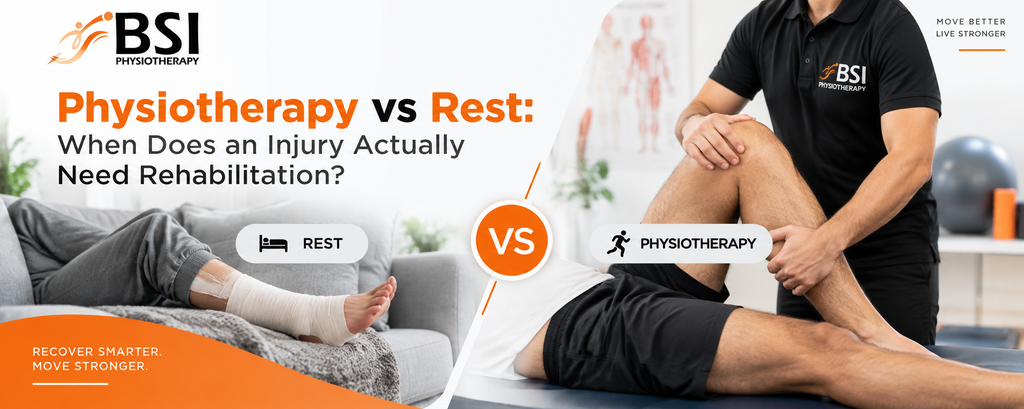
When you get injured, one of the first questions is often: “Should I rest, or do I need physiotherapy?”
For minor injuries, a short period of relative rest may be appropriate. But prolonged inactivity is not always the best approach. Many musculoskeletal injuries recover more effectively when rest is combined with progressive movement, targeted exercises and rehabilitation.
Understanding when to rest, when to start moving and when to consult a physiotherapist can help you avoid unnecessary delays in recovery.
What Is the Difference Between Rest and Rehabilitation?
Rest generally means reducing or temporarily avoiding activities that aggravate an injury.
Rehabilitation, on the other hand, is an active process designed to help you restore:
- Pain-free movement
- Muscle strength
- Flexibility and mobility
- Balance and coordination
- Joint stability
- Functional capacity
- Sport or work-related performance
Rest can be an important part of recovery, particularly during the early stages of some injuries. However, rehabilitation focuses on gradually helping the body return to normal function.
When Is Rest Appropriate After an Injury?
Immediately after an injury, reducing activities that increase pain can be useful.
For example, after a minor muscle strain or an acute flare-up of joint pain, you may need to temporarily modify your normal activities.
However, rest does not necessarily mean complete inactivity.
Depending on the injury, gentle movement within a comfortable range may be appropriate. Your rehabilitation plan should be based on the type and severity of the injury.
Rest may be useful when:
- A particular movement significantly increases your pain
- You have recently sustained an acute injury
- Swelling or irritation is limiting movement
- Your normal activity is repeatedly aggravating symptoms
- A healthcare professional has specifically advised activity restriction
The important distinction is between relative rest and prolonged complete rest.
Why Too Much Rest May Not Always Help
Avoiding movement for too long can have disadvantages.
Extended inactivity can contribute to:
- Muscle weakness
- Reduced joint mobility
- Loss of physical conditioning
- Reduced confidence in movement
- Difficulty returning to normal activities
- Reduced tolerance for exercise
This is why rehabilitation often involves gradually increasing physical activity as symptoms allow.
The goal isn’t to push through severe pain. Instead, the aim is to progressively expose the injured area to appropriate levels of movement and load.
When Does an Injury Need Physiotherapy?
Not every minor injury requires formal physiotherapy. However, professional assessment becomes particularly useful when symptoms are persistent, recurrent or affecting your ability to function.
You may benefit from physiotherapy if:
1. Pain Is Not Improving
If pain continues despite modifying your activities and allowing time for recovery, an assessment can help identify potential contributing factors.
Persistent pain may sometimes be related to movement patterns, muscle weakness, joint stiffness or inappropriate loading.
2. Your Movement Is Restricted
Difficulty moving a joint normally after an injury can affect how you perform everyday activities.
A physiotherapist can assess mobility and develop exercises aimed at gradually restoring movement.
3. You Have Lost Strength
After an injury or period of reduced activity, muscles around the affected area may become weaker.
Rehabilitation can use progressive strengthening to rebuild capacity.
4. The Injury Keeps Coming Back
Repeated injuries may indicate that simply resting until the symptoms disappear isn’t addressing the underlying problem.
A physiotherapist can assess factors such as:
- Strength
- Mobility
- Technique
- Load management
- Movement patterns
- Sport-specific demands
5. You Want to Return to Sport
Returning to sport is different from simply becoming pain-free.
An athlete may need to regain sufficient:
- Strength
- Power
- Agility
- Balance
- Coordination
- Sport-specific capacity
A structured rehabilitation program can help bridge the gap between “I don’t have much pain” and “I’m ready to perform.”
Physiotherapy Doesn’t Always Mean Massage
A common misconception is that physiotherapy is mainly about massage or passive treatment.
Modern physiotherapy can include a combination of:
- Exercise therapy
- Strength training
- Mobility exercises
- Manual therapy
- Movement retraining
- Balance and coordination training
- Sport-specific rehabilitation
- Education about activity and load management
The exact approach depends on the individual’s condition, goals and stage of recovery.
Rest vs Physiotherapy: Which One Do You Need?
It’s not always an either-or decision.
In many cases, rest and rehabilitation work together.
| Rest | Rehabilitation |
| Reduces aggravating activity | Gradually restores activity |
| Can help manage acute symptoms | Builds strength and capacity |
| May be useful early after some injuries | Helps restore function |
| Prevents excessive loading | Introduces appropriate loading |
| Usually temporary | Progresses as recovery improves |
The appropriate balance depends on the injury.
For example, an acute injury may initially require activity modification. As symptoms settle, a structured rehabilitation program may become increasingly important.
How Physiotherapy Can Help With Common Injuries
Physiotherapy may be used as part of rehabilitation for conditions such as:
Back Pain
Treatment may involve improving mobility, strengthening relevant muscle groups and gradually increasing tolerance for everyday activities.
Knee Injuries
Rehabilitation may focus on strength, mobility, balance and progressive loading.
Shoulder Injuries
Depending on the condition, treatment may include restoring shoulder mobility, strengthening the rotator cuff and improving shoulder function.
Sports Injuries
Sports rehabilitation often progresses from basic movement and strength exercises toward sport-specific drills and return-to-play testing.
Post-Surgical Rehabilitation
Following certain orthopaedic procedures, physiotherapy may be an important part of recovery. The rehabilitation program should follow the surgeon’s instructions and the individual’s clinical status.
How Long Should You Rest Before Starting Physiotherapy?
There is no universal number of days that applies to every injury.
The appropriate timing depends on factors such as:
- Type of injury
- Severity
- Location
- Pain and swelling
- Your age and general activity level
- Previous injuries
- Sport or work demands
- Surgical status, if applicable
Some injuries can benefit from early, carefully controlled movement, while others may require specific precautions.
If you’re unsure, an assessment by a qualified healthcare professional can help determine what level of activity is appropriate.
When Should You Seek Medical Assessment?
Not every injury should be managed with physiotherapy alone.
Seek appropriate medical assessment after a significant injury, particularly if you experience symptoms such as:
- Severe or rapidly increasing pain
- Major swelling
- Obvious deformity
- Inability to bear weight
- Significant loss of movement
- Numbness or progressive weakness
- Symptoms following major trauma
A physiotherapist can also identify situations where further medical evaluation or imaging may be appropriate.
Physiotherapy in Bangalore: Getting the Right Rehabilitation Approach
If you’re searching for physiotherapy in Bangalore, the most important consideration isn’t simply choosing between “rest” and “physiotherapy.”
The more useful question is:
“What level of activity is appropriate for my injury right now, and how can I safely progress from there?”
At BSI Physiotherapy, rehabilitation can be tailored according to the individual’s symptoms, functional goals and activity requirements. Assessment may help determine whether you need activity modification, mobility work, strengthening, sports rehabilitation or a combination of approaches.
Whether you’re recovering from a sports injury, managing persistent musculoskeletal pain or returning to activity after surgery, the goal is to progressively restore function rather than simply wait for symptoms to disappear.
Frequently Asked Questions
Is rest better than physiotherapy for an injury?
Rest and physiotherapy serve different purposes. Rest or activity modification may help reduce aggravating symptoms, while rehabilitation focuses on restoring movement, strength and function. Many injuries require an appropriate combination of both.
Can physiotherapy make an injury worse?
Appropriately prescribed physiotherapy should be adjusted according to the person’s symptoms and stage of recovery. Exercises may need to be modified if they significantly aggravate symptoms.
Should I wait until my pain completely disappears before exercising?
Not necessarily. The appropriate amount of activity depends on the injury. In many cases, gradual and controlled loading is part of recovery, but the type and intensity of exercise should be appropriate for the condition.
How do I know if I need physiotherapy?
Consider an assessment if your symptoms are persistent, your movement or strength is limited, the injury repeatedly returns, or you’re having difficulty returning to work, exercise or sport.
Is physiotherapy useful for sports injuries?
Yes. Sports physiotherapy can address strength, mobility, movement, load management and sport-specific requirements as part of a return-to-sport program.
Final Takeaway
Rest can help an injured body settle down, but recovery often requires more than simply waiting.
For many musculoskeletal injuries, the long-term goal is to gradually restore movement, strength, confidence and the ability to perform normal activities.
If your injury isn’t improving, keeps returning or is preventing you from getting back to the activities you enjoy, a physiotherapy assessment can help determine the next appropriate step.
Looking for physiotherapy in Bangalore? BSI Physiotherapy provides assessment and rehabilitation for musculoskeletal, sports and orthopaedic conditions.
Medical note: This article provides general educational information and is not a substitute for an individual clinical assessment. Rehabilitation recommendations should be tailored to the specific injury and patient.