
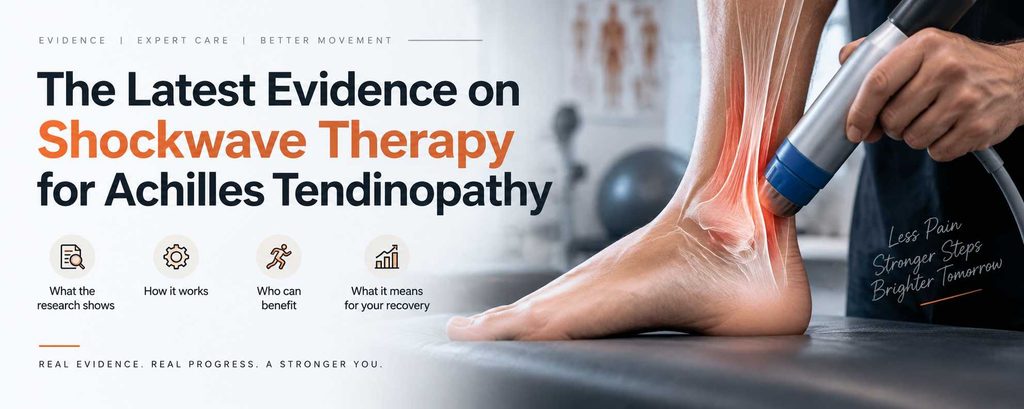
Achilles tendinopathy can be frustrating. Pain may interfere with running, walking, jumping, climbing stairs, or even everyday activities, and recovery can take considerably longer than expected.
Because of this, many people with persistent Achilles pain are offered extracorporeal shockwave therapy (ESWT) as part of their rehabilitation. Shockwave therapy has become a popular treatment in sports physiotherapy, but an important question remains:
Does the latest scientific evidence actually support shockwave therapy for Achilles tendinopathy?
The answer is more nuanced than simply saying that shockwave therapy “works” or “doesn’t work.”
Earlier research suggested potential benefits, particularly when shockwave therapy was combined with an appropriate tendon-loading programme. However, newer systematic reviews and meta-analyses published in 2026 have raised important questions about how much benefit shockwave therapy provides compared with placebo or other treatments.
Understanding this distinction can help patients and clinicians make better-informed treatment decisions.
What Is Achilles Tendinopathy?
The Achilles tendon connects the calf muscles to the heel bone and plays a major role in walking, running and jumping.
Achilles tendinopathy refers to a painful condition involving the Achilles tendon, usually associated with changes in tendon structure and its ability to tolerate load.
It commonly develops when the demands placed on the tendon exceed its current capacity to adapt.
Common symptoms include:
- Pain around the Achilles tendon
- Stiffness, particularly after waking up or periods of inactivity
- Pain during or after running
- Tenderness when the tendon is pressed
- Difficulty with jumping or pushing off
- Reduced sporting performance
Achilles tendinopathy is generally divided into two broad categories:
Midportion Achilles tendinopathy
This affects the tendon several centimetres above its attachment to the heel and is frequently seen in runners and jumping athletes.
Insertional Achilles tendinopathy
This occurs where the Achilles tendon attaches to the heel bone. The rehabilitation approach can differ from that used for midportion tendinopathy because compression at the tendon insertion may also contribute to symptoms.
Accurate assessment is therefore important before deciding whether shockwave therapy is appropriate.
What Is Shockwave Therapy?
Extracorporeal shockwave therapy uses acoustic energy delivered through a treatment applicator to a targeted area.
There are different forms of shockwave treatment, including radial shockwave therapy and focused shockwave therapy.
The proposed biological effects of shockwave therapy include mechanical stimulation of tissues and changes in pain signalling and tissue responses. These mechanisms have provided a rationale for using ESWT in several chronic musculoskeletal conditions.
However, understanding how a treatment might work biologically is not the same as proving that it produces meaningful improvements for patients.
That distinction is particularly important with Achilles tendinopathy.
What Did Earlier Research Show?
Earlier systematic reviews produced more encouraging findings.
For example, a 2022 systematic review reported moderate evidence supporting ESWT when added to a tendon-loading programme for midportion Achilles tendinopathy. However, the same review found limited evidence supporting ESWT for insertional Achilles tendinopathy.
Other earlier reviews were less certain. A systematic review and meta-analysis examining ESWT as a standalone treatment found very-low-quality evidence and did not identify a clear advantage over other conservative treatments.
This means the evidence was never as straightforward as some treatment advertisements suggested.
What Does the Latest Evidence Show?
A major 2026 systematic review and meta-analysis published in the Journal of Orthopaedic & Sports Physical Therapy examined nine randomised controlled trials involving 557 participants with midportion or insertional Achilles tendinopathy.
The researchers compared shockwave therapy with sham treatment, no treatment and other interventions.
The findings were important.
For insertional Achilles tendinopathy, shockwave therapy did not demonstrate a clinically meaningful advantage over sham treatment.
For midportion Achilles tendinopathy, the analysis also did not find consistent clinically meaningful improvements in pain or disability compared with control interventions across the different follow-up periods.
The researchers also found no clear evidence that radial shockwave was superior to focused shockwave, or vice versa.
Overall, the authors concluded that shockwave therapy should not currently be considered a routine treatment for Achilles tendinopathy, particularly because much of the available evidence remains low or very-low certainty.
This does not necessarily mean that shockwave therapy can never help an individual patient. Instead, it means that the current evidence does not justify assuming that ESWT provides a clinically important benefit for Achilles tendinopathy in general.
Why Does the Evidence Appear Conflicting?
One reason is that Achilles tendinopathy studies differ considerably.
Researchers may use different:
- Shockwave devices
- Energy levels
- Number of sessions
- Treatment intervals
- Treatment locations
- Patient populations
- Definitions of Achilles tendinopathy
- Exercise programmes
- Follow-up periods
For example, one patient may receive shockwave therapy alone, while another receives shockwave alongside progressive calf strengthening and activity modification.
It becomes difficult to determine whether improvements are caused by shockwave therapy itself, the rehabilitation programme, natural recovery, or a combination of factors.
This is one reason high-quality controlled trials are so valuable.
Does Shockwave Therapy Replace Exercise-Based Rehabilitation?
This is one of the most important points for patients.
Shockwave therapy should not be viewed as a replacement for appropriate rehabilitation.
Achilles tendons respond to mechanical loading. A carefully progressed strengthening programme can help improve the tendon’s capacity to tolerate the demands placed on it.
Depending on the individual, rehabilitation may involve:
- Adjusting running or sporting loads
- Calf strengthening
- Progressive tendon loading
- Balance and lower-limb strength work
- Gradual return to running or jumping
- Addressing contributing biomechanical or training factors
The exact programme should be individualised rather than copied from a generic exercise list.
The earlier evidence suggesting a potential benefit from ESWT was particularly relevant when the treatment was used alongside a tendon-loading programme rather than treated as a standalone solution.
What About Pain Relief?
Pain relief is an important outcome, but it should not be the only measure of recovery.
A person may experience temporary changes in pain without having regained the strength and load tolerance needed to return safely to running or sport.
A 2025 meta-analysis of eight randomised trials involving 458 participants found no clear overall benefit of ESWT compared with sham treatment for chronic Achilles tendinopathy. An exploratory subgroup analysis suggested that patients with symptoms lasting less than 12 months might experience short-term pain improvements, but the authors emphasised that more high-quality research is needed.
This is a good example of why clinicians need to interpret research carefully rather than focusing on one positive finding.
Is Shockwave Therapy Safe?
ESWT is generally considered a non-invasive treatment, but “non-invasive” does not mean “risk-free.”
Treatment can cause temporary discomfort or soreness, and patients should be assessed before treatment.
Importantly, the 2026 systematic review reported two Achilles tendon ruptures following focused shockwave therapy among the included evidence. This finding does not establish that shockwave therapy caused those ruptures, but it reinforces the importance of appropriate patient selection, treatment parameters and clinical supervision.
Anyone with significant Achilles pain, sudden weakness, a suspected rupture or a sudden “pop” in the tendon should receive an appropriate clinical assessment rather than simply proceeding with shockwave treatment.
So, Should You Have Shockwave Therapy for Achilles Tendinopathy?
There is no universal answer.
The latest evidence suggests that shockwave therapy should not automatically be considered a standard treatment for every person with Achilles tendinopathy.
Instead, treatment should begin with a proper assessment to understand:
- Where the pain is located
- Whether the problem is midportion or insertional
- How long symptoms have been present
- Current tendon-loading capacity
- Sporting and occupational demands
- Previous treatment
- Other possible causes of heel or ankle pain
For many patients, progressive rehabilitation and appropriate load management remain central components of care.
Shockwave therapy may still be discussed as an option in selected situations, but patients should understand the uncertainty surrounding its additional benefit.
What Does This Mean for Athletes?
For runners and athletes, the goal should not simply be “How quickly can I remove the pain?”
A better question is:
“How can I safely rebuild my Achilles tendon’s capacity so that I can return to the activity I want to do?”
That requires more than a passive treatment.
A successful return to sport may involve progressive calf strength, running-load management, jumping drills, movement assessment and a gradual increase in sporting demands.
Shockwave therapy, where considered, should fit into that larger rehabilitation strategy rather than become the entire treatment plan.
The Bottom Line
The evidence surrounding shockwave therapy for Achilles tendinopathy has evolved.
Earlier research suggested potential benefits, particularly when ESWT was combined with exercise-based rehabilitation for midportion Achilles tendinopathy. However, newer evidence published in 2026 has found no clinically meaningful overall advantage over control treatments, while also highlighting that much of the evidence remains uncertain or low quality.
Therefore, shockwave therapy should not be promoted as a guaranteed solution or a replacement for rehabilitation.
The most evidence-informed approach is to assess the individual, identify the factors contributing to the tendon problem, manage load appropriately and develop a progressive rehabilitation programme.
If shockwave therapy is considered, patients should be given a realistic explanation of the potential benefits, limitations and uncertainties.
Good Achilles rehabilitation is not about finding one “magic” treatment. It is about matching the right treatment strategy to the individual and progressively restoring the tendon’s ability to handle real-world demands.
Frequently Asked Questions
Can shockwave therapy cure Achilles tendinopathy?
Current evidence does not support describing shockwave therapy as a guaranteed cure. Its overall additional benefit for Achilles tendinopathy remains uncertain.
Is shockwave therapy better than exercise?
The latest evidence does not show a clinically meaningful overall advantage of shockwave therapy over control interventions. Exercise-based tendon rehabilitation remains an important part of management.
Does shockwave therapy work for insertional Achilles tendinopathy?
Current evidence does not demonstrate a clinically meaningful benefit over sham treatment for insertional Achilles tendinopathy.
What should I do if Achilles pain is not improving?
Seek an assessment from a qualified physiotherapist or sports-medicine professional. The diagnosis, tendon location, training load and rehabilitation programme should be reviewed before deciding on additional treatments.
Can I continue running with Achilles tendinopathy?
In many cases, complete rest is not necessary, but running loads may need to be modified according to symptoms and tendon capacity. A physiotherapist can help establish an appropriate progression.
References
- JOSPT, 2026: Systematic review and meta-analysis of shockwave therapy for midportion and insertional Achilles tendinopathy.
- Meta-analysis of ESWT versus sham ESWT for chronic Achilles tendinopathy.
- Systematic review of ESWT for midportion and insertional Achilles tendinopathy.
- Systematic review and meta-analysis examining ESWT as monotherapy for Achilles tendinopathy.