
Is Text Neck Real? Understanding the Epidemic and Its Physiotherapy Fix
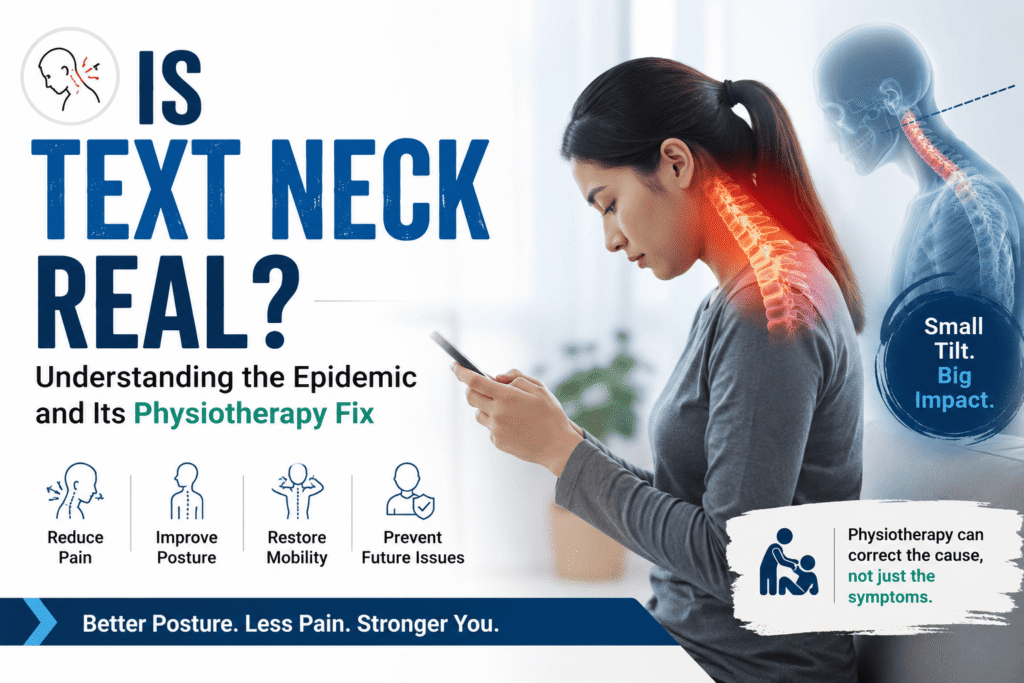
If you’ve ever finished a long day of scrolling Instagram, replying to WhatsApp messages, or hunching over your laptop for back-to-back Zoom calls only to feel a dull ache creeping up your neck and into your shoulders, you’ve already met “text neck” — even if you didn’t know its name.
Text neck syndrome isn’t a myth, a marketing term, or something only “weak-postured” people get. It’s a real, measurable, and increasingly common musculoskeletal condition, and in India it’s showing up earlier and more severely than most people expect. Let’s break down what the science actually says, why India is seeing such a sharp rise in cases, and how physiotherapy offers one of the most effective, non-invasive ways to reverse it.
What Exactly Is Text Neck Syndrome?
Text neck syndrome is a repetitive strain injury caused by prolonged forward head posture — the position your neck takes when you tilt your head down to look at a smartphone, tablet, or laptop screen. The term was originally coined by an American chiropractor to describe this modern postural pattern, but the underlying mechanics are simple physics.
Your head weighs roughly 4.5 to 5.5 kg in a neutral, upright position. But every degree you tilt it forward multiplies the effective load on your cervical spine. At a 45–60 degree tilt — the angle most people adopt
while texting — the effective strain on the neck can increase several times over, forcing your neck, shoulder, and upper back muscles to work far harder than they are designed to.
Over time, this leads to:
- Chronic neck and upper back pain
- Tension headaches
- Rounded shoulders and a forward-hunched posture
- Reduced neck mobility and stiffness
- In advanced cases, nerve compression, disc degeneration, and early cervical spondylosis
The Rise of Text Neck in India: A Data-Backed Reality
India isn’t just witnessing this trend — it’s becoming one of its epicentres, driven by the country’s explosive smartphone adoption and increasingly screen-heavy work and education culture.
The scale of the problem
By 2020, the number of smartphone users in India had already crossed 748 million, and that figure has only grown since. With affordable data plans, remote learning, and hybrid work becoming the norm post-pandemic, average daily screen time for Indian users — particularly students and young professionals — has climbed steadily.
What Indian research is finding
- A cross-sectional study among junior college students in Sangli, Maharashtra found that 72.3% of participants showed measurable neck disability linked to text neck syndrome, with a statistically significant link between longer smartphone usage and worsening symptoms.
- A study among undergraduate medical students in Chennai found that a large proportion reported mild to severe self-rated neck disability using the Neck Disability Index (NDI), a clinically validated screening tool.
- Broader analyses comparing Indian and Pakistani university populations found text neck prevalence rates in the 40s (percentage-wise) among young adults, with neck-related musculoskeletal complaints among mobile device users ranging widely depending on population and screen habits.
- Interestingly, awareness remains low: one Indian survey found that while a section of the population had heard the term “text neck,” only a small fraction actually understood what it meant or how to prevent it.
Why India specifically?
A few compounding factors are unique to the Indian context:
- Young, digitally-native population — India has one of the youngest median ages globally, and this demographic is also the most screen-engaged, often starting smartphone use in early adolescence.
- Education shifted online — Post-COVID, students across metros and tier-2/tier-3 cities alike now attend classes, coaching sessions, and even exams on laptops and phones for hours daily.
- WFH and hybrid work culture — IT hubs like Bengaluru, Hyderabad, Pune, and Gurugram have large white-collar workforces spending 8–10 hours a day on screens, often without ergonomic furniture at home.
- Low ergonomic awareness — Unlike posture-conscious corporate cultures in some Western countries, ergonomic education is still nascent in most Indian schools, colleges, and workplaces.
- Commute and public transport habits — Long train and metro commutes in cities like Mumbai and Delhi are frequently spent scrolling phones in cramped, poorly supported postures.
Put together, these factors mean text neck in India is not confined to any one age group — it is affecting schoolchildren, college students, IT professionals, and even homemakers who spend hours on mobile devices.
How Physiotherapy Treats and Reverses Text Neck
The encouraging news is that text neck syndrome is highly responsive to physiotherapy, especially when addressed early. Physiotherapists in India are increasingly seeing text neck-related complaints in outpatient clinics, and treatment protocols are well established.
1. Postural Assessment and Correction
A qualified physiotherapist begins with a detailed postural and movement assessment — checking cervical range of motion, forward head posture angle, shoulder alignment, and muscle strength imbalances. This forms the baseline for a personalised treatment plan.
2. Manual Therapy
Hands-on techniques such as myofascial release, soft tissue mobilisation, and joint mobilisation help reduce muscle tightness in the upper trapezius, levator scapulae, and sub-occipital muscles — the areas most affected by prolonged screen use.
3. Therapeutic Exercises
Physiotherapy for text neck typically includes:
- Chin tucks to strengthen deep neck flexors and retrain neutral head position
- Scapular retraction exercises to counter rounded shoulders
- Thoracic extension stretches to improve upper back mobility
- Neck isometrics to build endurance in postural muscles without aggravating pain
4. Ergonomic Coaching
This is where physiotherapy goes beyond pain relief. Physiotherapists guide patients on practical, India-relevant adjustments — like screen height for laptop use during long WFH hours, phone-holding habits during commutes, and study desk setups for students preparing for competitive exams.
5. Modalities for Pain Relief
In acute or painful cases, physiotherapists may use ultrasound therapy, TENS (transcutaneous electrical nerve stimulation), or heat therapy to reduce inflammation and pain before progressing to active rehabilitation.
6. Long-Term Habit Building
Perhaps most importantly, physiotherapy addresses the behavioural root of text neck. Patients are taught the “20-20-20” screen break rule, guided stretching routines to do between meetings or classes, and self-monitoring techniques to catch poor posture before it becomes chronic.
When Should You See a Physiotherapist?
You do not need to wait for severe pain to seek help. Consider consulting a physiotherapist if you notice:
- Persistent neck stiffness after screen use
- Headaches that worsen through the day
- Tingling or numbness radiating into your shoulders or arms
- Visibly rounded shoulders or a forward-jutting head posture
- Reduced ability to turn your head fully
Early intervention is significantly more effective — and faster — than treating advanced cervical degeneration later.
The Bottom Line
Text neck syndrome is very real, and India’s smartphone-driven, screen-heavy lifestyle has made it one of the fastest-growing postural health concerns in the country today. The good news is that it is also one of the most preventable and treatable conditions when addressed with the right combination of physiotherapy, ergonomic correction, and consistent postural habits.
If you are experiencing recurring neck pain, do not dismiss it as “just from stress” or “just from studying.” A qualified physiotherapist can assess your posture, identify the root cause, and put you on a structured path to recovery — before a manageable ache turns into a long-term spinal issue.
This article is intended for general informational purposes and does not replace professional medical advice. If you are experiencing persistent or severe neck pain, please consult a licensed physiotherapist or physician for a personalised assessment.